Ingrained or Engrained – What’s the Real Difference?
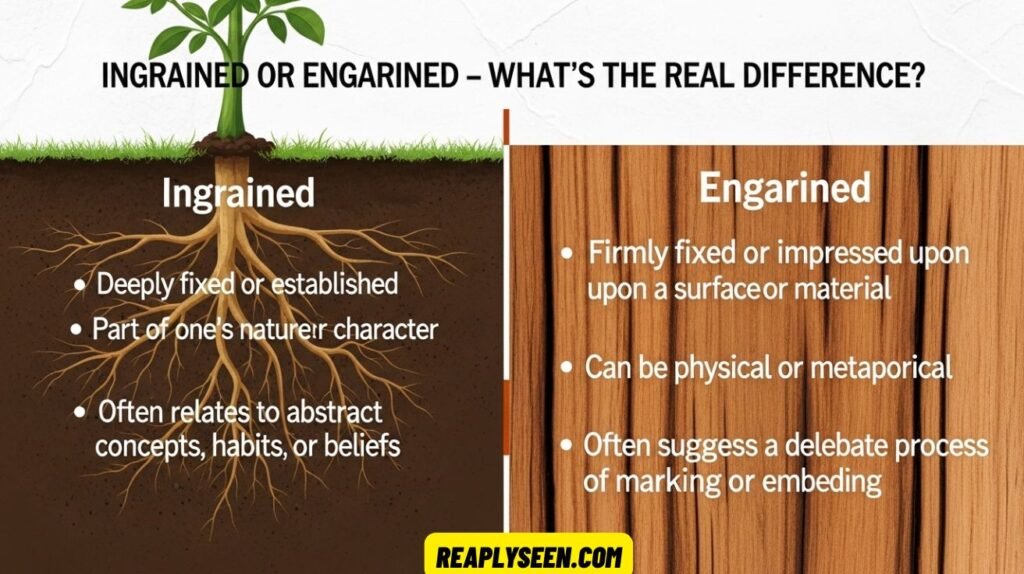
Ingrained or Engrained means something that is very fixed or hard to change. It can describe habits, beliefs, or behaviors. Ingrained is the correct and modern spelling, while engrained is old and rare.
Many people get confused between ingrained and engrained. The words look very similar. Choosing the right one can make writing clear and correct.
Ingrained comes from the word “ingrain,” which means to fix color into fabric. Over time, it came to mean habits or ideas that stay strong. Using ingrained shows proper English and avoids mistakes.
What Does “Ingrained” Actually Mean?

At its core, ingrained meaning refers to something that is firmly fixed, deeply rooted, or almost impossible to change. When we say a habit or belief is ingrained, we imply that it is not superficial but permanent. For example, a person may have deeply rooted habits of waking up early, or someone might hold firmly established traits like honesty or patience. These qualities are not temporary; they form part of a person’s identity and behavior over time. Ingrained is often used to describe behaviors, values, and cultural norms that are passed down or developed over years. This depth and permanence is what sets it apart from casual habits or fleeting ideas.
The word can be applied in many contexts, such as saying, “Her sense of responsibility is ingrained in her personality,” or “The fear of failure is ingrained in his mindset.” Here, it shows that the behavior or feeling is deeply fixed, almost impossible to remove or ignore.
Common Uses of “Ingrained”
Ingrained is most often used in relation to habits, beliefs, or behaviors. For instance, someone might refer to embedded habits of brushing teeth every morning, entrenched ideas about fairness, or permanent behavior such as always keeping promises. People use the term in personal, social, and professional contexts.
In professional writing, English word usage favors ingrained when describing enduring traits. Saying, “He has an ingrained work ethic,” conveys a stronger, more precise meaning than simply saying “he works hard.” Similarly, in psychology or personal development, ingrained habits often refer to patterns that are formed over many years and require conscious effort to change.
The word is flexible enough to cover both personal traits and cultural ideas, such as “Respect for elders is ingrained in many cultures,” demonstrating the connection to cultural beliefs.
Origins and Etymology: Tracing “Ingrained”
Understanding the history of a word helps explain why it carries its current meaning. The word ingrained comes from the verb ingrain, which originally described the process of fixing dye into fabric so that it would not wash out. The prefix “in-” literally means “into,” while “grain” refers to the texture or fibers of the cloth. This process produced a color that was deeply fixed and long-lasting, which eventually led to the metaphorical use of ingrained for habits, beliefs, and traits.
Over time, language evolution allowed the meaning to broaden. No longer limited to textiles, ingrained came to describe anything that was firmly established, difficult to remove, and permanent. Historical texts often use the word in this metaphorical sense, highlighting the word’s journey from a technical term to a commonly used adjective.
In summary, ingrained combines literal and figurative meanings: it represents both the physical process of deeply fixing something and the abstract concept of firmly established traits in human behavior.
What About “Engrained”?
The word engrained shares the same origin and meaning as ingrained. It also comes from the verb engrain, which historically meant the same as ingrain. However, engrained spelling uses the prefix “en-,” which in English often means “to cause to be” or “to put into.” This made engrained a variant spelling that appeared in older texts.
While both words mean the same thing, engrained is considered an archaic word form in modern English. Writers today rarely use it, and most style guides and dictionaries prefer ingrained. Despite this, you may still encounter engrained in historical documents, poetry, or British texts from earlier centuries.
Why is “Engrained” Rare?
The decline of engrained in modern writing reflects the natural tendency of English to favor one standard spelling. Over time, old-fashioned spelling variants fall out of use to simplify communication. Dictionaries, grammar guides, and modern style manuals largely recommend ingrained as the standard, while engrained is now labeled as rare or even incorrect.
Data also shows the disparity clearly. According to Google Books Ngram Viewer, ingrained appears nearly fifty times more frequently than engrained in texts published between 1800 and 2023. This illustrates how the language has moved toward consistency and simplicity, favoring one recognized standard over historical variants.
Example of “Engrained” Usage
Historically, writers may have used engrained in sentences like, “His values were engrained by years of experience.” While grammatically correct, this usage now appears old-fashioned. In modern English, the sentence would almost always use ingrained, reflecting the word’s dominance in dictionary spelling standard and modern English usage.
Ingrained vs. Engrained: Usage in Modern English
Today, ingrained is the correct and widely accepted spelling in both American and British English. While engrained may appear in historical texts or in specific literary contexts, it is generally considered outdated. Modern writers, editors, and teachers consistently use ingrained to describe deeply rooted habits, firmly established traits, or permanent behavior.
Usage Frequency (Based on Google Books Ngram Data, 1800-2023)
A look at historical usage confirms what style guides say. From 1800 to 2023, ingrained steadily increased in frequency, while engrained steadily declined.
| Word | Frequency per Million Words | Trend Since 1900 |
| Ingrained | 0.15 | Increasing steadily |
| Engrained | 0.003 | Decreasing steadily |
This data shows that ingrained is nearly fifty times more common than engrained, supporting its place as the correct spelling ingrained in modern writing.
Geographic and Style Notes
In the United States, ingrained is almost exclusively used. British English occasionally used engrained in older texts, but even modern British English favors ingrained. Formal writing, academic papers, news articles, and style guides all recommend ingrained as the preferred spelling. Choosing engrained in contemporary writing may appear as a common mistake in writing.
See Also : Heard vs Herd vs Hurd: What’s the Real Difference?
The Verbs Behind Them: Ingrain and Engrain
What Does “Ingrain” Mean?
The verb ingrain means to firmly fix or establish something. Originally used for dyeing fabric, it now applies to ideas, habits, and behaviors. A teacher might ingrain good study habits in students, while parents might ingrain respect for elders in their children. Here, the verb directly leads to the adjective ingrained, describing traits that are deeply fixed and permanent.
What About “Engrain”?
The verb engrain is now largely obsolete. It once meant the same as ingrain, but its usage is mostly limited to historical or regional contexts. For example, “The custom was engrained in the local culture” could be found in older texts, but today we would say “ingrained.”
How Verbs Affect the Adjectives
The rarity of engrain means that engrained is also rare. In contrast, ingrain forms the foundation of the modern, widely recognized adjective ingrained, showing the connection between verbs and adjectives in English word usage.
Real-Life Examples: How to Use “Ingrained” Correctly
Using ingrained correctly requires understanding its meaning. It refers to traits, habits, or beliefs that are firmly established and deeply fixed. For example, “His ingrained habit of reading every morning shapes his day.” In business, one might say, “Customer-first principles are ingrained in our company culture.” These examples demonstrate proper application in personal, professional, and social contexts.
Correct Usage Examples
- “Her ingrained sense of discipline comes from years of training.”
- “The fear of failure is ingrained in many students.”
- “Respect for cultural traditions is ingrained in their community.”
Common Mistakes to Avoid
A frequent error is using engrained in modern writing. While understandable, it is considered an archaic word form today. Another mistake is applying ingrained to shallow or temporary habits. The term implies depth and permanence, so avoid using it for casual or fleeting behaviors. Understanding American vs British English differences can also prevent missteps.
Quick Tips to Remember
When in doubt, choose ingrained. Think of the prefix “in-” as going into something, showing depth. Use engrained only when quoting historical texts or literature. Remember, ingrained is the dictionary spelling standard and the preferred choice in modern English usage.
See Also : To Bad or Too Bad: The Quick Grammar Rule for 2026
Why “Ingrained” Has Won the Language Battle
Linguistic Evolution and Simplicity
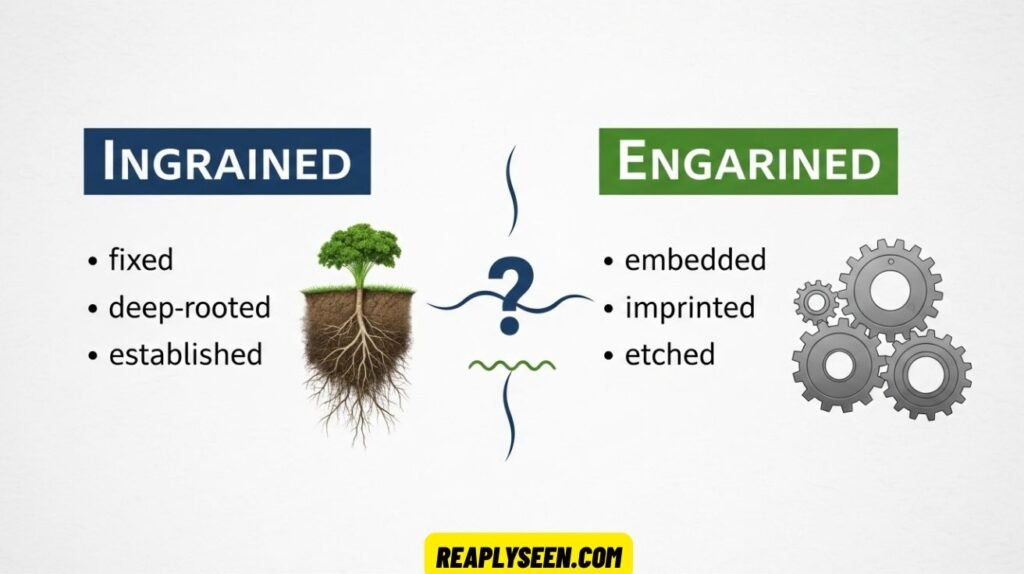
English naturally favors clarity and consistency. Words like ingrained simplify communication, while engrained falls out of use due to its old-fashioned spelling. The prefix “in-” is logical and easier to understand, reinforcing its dominance.
Style Guides and Dictionaries
Merriam-Webster, Oxford English Dictionary, and the Chicago Manual of Style all confirm that ingrained is the standard. Style guides emphasize its use in formal writing, professional communication, and educational materials.
Popular Culture and Media
From newspapers to books, websites, and broadcasts, ingrained is nearly universal. Its prevalence in media reinforces its use among readers, further diminishing the use of engrained.
Why People Confuse Ingrained and Engrained
Many readers stumble when deciding between ingrained and engrained because the words look almost identical. The similarity in spelling causes confusion, especially for those who rarely check a dictionary. Misunderstanding arises when people assume both forms are equally correct in modern English, but only one has become widely accepted in daily writing.
The confusion also spreads because older texts often use engrained. While understandable historically, these examples are now considered outdated. Writers need to focus on modern usage rules, especially in professional and academic contexts. Knowing the correct spelling ingrained ensures clarity and avoids unnecessary mistakes.
The Power of Ingrained Habits in Daily Life
Habits that are ingrained in our daily routines often go unnoticed but shape our productivity and mindset. When behaviors are repeated consistently, they become automatic, almost like muscle memory. Such deeply rooted habits influence decisions, health, and social interactions, making them crucial for personal growth.
Psychologists often study how these permanent behaviors form. By understanding ingrained habits, people can identify patterns they want to change or reinforce. For example, a student may develop embedded habits of focused study, which later become a lifelong trait.
Historical Origins: From Fabric to Mind
The word ingrained originates from textile dyeing, where colors were fixed deeply into fibers to prevent fading. Over time, the term evolved metaphorically to describe traits and beliefs that become permanent in a person or society. This shows how language evolution turns technical terms into everyday descriptors.
The metaphorical shift reflects the human tendency to compare behaviors to physical processes. Just as dye permanently stains fabric, certain habits or entrenched ideas can remain fixed in a person’s character. This etymology helps us understand why ingrained implies depth and permanence.
Engrained: A Rare and Archaic Variant
Though once more common, engrained has become an archaic word form in modern English. It appears primarily in historical texts or British literature, but even there it is increasingly rare. Modern dictionaries and style guides classify it as a variant and advise writers to use ingrained instead.
Using engrained today can make writing seem old-fashioned or incorrect. While its meaning is identical to ingrained, its appearance in professional contexts is limited. Writers who wish to follow contemporary dictionary spelling standards should stick to the widely accepted form.
Modern English Usage: Choosing the Right Word
In contemporary English, ingrained is overwhelmingly preferred in both American and British writing. It is the standard spelling recommended by dictionaries and grammar guides, reflecting the simplification of language over time. Using it correctly avoids the common mistakes in writing associated with outdated forms.
Even in media, books, and online content, ingrained dominates. Understanding this preference is essential for clarity and credibility. Authors, students, and professionals should consistently choose ingrained to describe firmly established traits or deeply fixed habits in modern communication.
The Role of Ingrain and Engrain Verbs
The adjectives ingrained and engrained originate from the verbs ingrain and engrain, respectively. While ingrain remains active in modern usage, engrain is almost obsolete. Understanding this connection clarifies why engrained spelling is rare, while ingrained is the default in contemporary writing.
The verbs also illustrate the process of embedding traits or behaviors. For instance, teachers ingrain positive habits in students, making them long-lasting. This relationship between verb and adjective reinforces why choosing ingrained aligns with correct and current English word usage.
See Also : What Does “Hi There” Really Mean? A No-Nonsense Guide
Ingrained in Culture and Beliefs
Certain cultural beliefs are ingrained across generations, shaping traditions and social norms. For example, respect for elders or rituals passed down through families represents firmly established traits that influence behavior unconsciously. These beliefs become part of the collective identity of a society.
Similarly, individual values, like honesty or punctuality, can be deeply fixed through upbringing. Recognizing these embedded habits helps people understand how culture impacts daily decisions and why the word ingrained is often used metaphorically in literature and education.
Common Mistakes in Using Ingrained and Engrained
Many writers mistakenly use engrained in modern texts, assuming it is equally correct. This is a frequent common mistake in writing because older resources or literary works feature the variant. In academic or professional contexts, using engrained may appear outdated.
Another mistake is applying ingrained to temporary behaviors. The term implies permanent behavior or entrenched ideas, so it should not describe casual or fleeting actions. Understanding its proper meaning ensures accurate and effective communication in all types of writing.
Why Ingrained Has Become the Standard
Ingrained has won the language battle due to its simplicity and clarity. Unlike engrained, its prefix “in-” clearly communicates depth, making it more intuitive for readers. Grammar and style guides support its use in both informal and formal contexts, reinforcing its dominance.
Additionally, consistent use in media, textbooks, and literature has cemented ingrained as the preferred spelling. Its adoption across generations and institutions demonstrates how language evolution favors standardization and avoids old-fashioned spelling variants.
Quick Reference Table: Ingrained vs. Engrained
| Aspect | Ingrained | Engrained |
| Meaning | Deeply fixed or firmly rooted | Same meaning, less common |
| Frequency | Very common | Rare/archaic |
| Verb Origin | Ingrain | Engrain |
| Geographic Use | US & UK (modern) | Mostly historical or regional |
| Formal Writing | Preferred | Not recommended |
| Example Sentence | “Her ingrained fear won’t go away.” | “His values were engrained.” (archaic) |
FAQs
Is it deeply ingrained or deeply engrained?
The correct and widely accepted form is deeply ingrained; “engrained” is archaic and rarely used.
What is the difference between ingrain and engrave?
Ingrain means to firmly fix or embed (ideas, habits), while engrave refers to carving or etching into a surface.
Is it ingrained or engrained in memory?
The proper expression is ingrained in memory, meaning something is firmly fixed and hard to forget.
How do you use “ingrained” in a sentence?
Example: “Her ingrained habit of reading every morning shapes her day and mindset.”
Conclusion
In the discussion of Ingrained or Engrained, the correct and widely accepted word is ingrained. It describes habits, beliefs, and traits that are deeply fixed and firmly established. People use it in writing and speaking to show something permanent or important. The word comes from a long history, starting from dyeing fabric and later describing ideas that stay strong in a person or culture. Engrained is an older form and appears rarely in modern English. Using ingrained ensures clear and correct communication in school, work, and everyday life.
Choosing the right word helps readers understand your message. Writers should focus on ingrained in modern writing. This simple choice improves clarity and avoids mistakes. Following this rule also respects grammar and style guides in both American and British English. By using ingrained instead of engrained, you show careful, accurate writing and strong English skills. It is a small change that makes a big difference in clear communication.