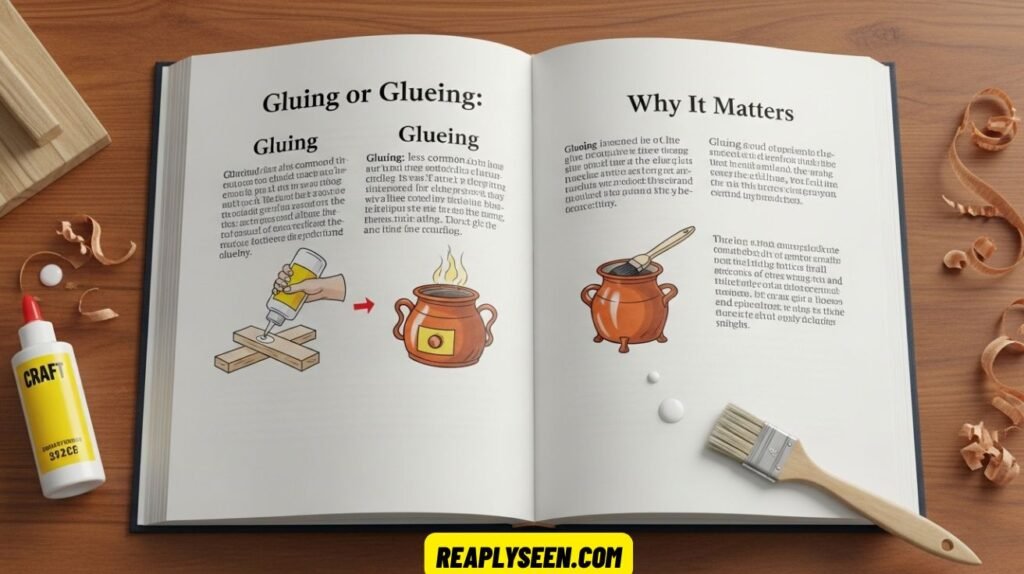
Gluing or Glueing: Which Spelling Is Correct and Why It Matters
Gluing or Glueing means sticking things together using glue. It is the present participle of the verb “to glue.” People use it in crafts, school work, and many daily activities.
Many people get confused about gluing or glueing. Some write glueing, but it is not correct in American English. Knowing the right spelling makes writing easy and correct.
The correct spelling in American English is gluing. British English sometimes uses glueing, but it is rare. Using gluing helps students and writers avoid mistakes and write clearly.
The Real Answer — Which Is Correct: Gluing or Glueing?

The simple answer is that in American English spelling, the correct form is gluing. Major dictionaries such as Merriam-Webster, Oxford English Dictionary, and the Cambridge Dictionary list gluing as the standard form. The confusion arises because some writers mistakenly think the “e” in glue should stay when adding “-ing,” but this goes against the well-established silent “e” rule in English spelling rules.
To understand why gluing is correct, we need to look at the verb conjugation rules in English. When a verb ends in a silent -e, you drop the -e before adding -ing to form the present participle. This applies to verbs like make → making, bake → baking, and glue → gluing. On the other hand, glueing is considered outdated and is rarely used in the United States. Even though some British English spelling references recognize glueing as a variant, gluing remains the dominant and accepted form everywhere in professional and academic writing.
Quick Grammar Tip
Here’s a simple grammar tip to avoid mistakes when forming present participles: If a verb ends with a silent -e, drop the e before adding -ing. This rule is part of standard English grammar and helps maintain spelling consistency. For example, verbs such as make → making, bake → baking, love → loving, and glue → gluing follow this rule perfectly.
Exceptions exist, especially for verbs ending in -ee or -ye like agree → agreeing and dye → dyeing, where the e is retained. Understanding this simple tip can help students and writers remember the correct spelling without constantly checking dictionaries or spellcheckers. Following this rule ensures your writing clarity and avoids common spelling mistakes in English.
Why the Spelling Confusion Happens in the First Place
Even experienced writers sometimes wonder if glueing is correct or not, and this confusion stems from the peculiarities of English spelling. The root word glue ends with -ue, which can trick people into keeping the e when adding -ing. Many writers believe keeping the e preserves pronunciation, but in reality, the drop silent e rule has been part of English spelling rules for centuries.
Historically, before spelling became standardized in the 18th and 19th centuries, both gluing and glueing appeared in manuscripts and printed works. This is why some dictionaries and older texts may list glueing, but modern usage overwhelmingly favors gluing. Understanding this aspect of language variation helps learners see that English spelling is sometimes more about rules than phonetics.
| Base Verb | Correct Present Participle | Why? |
| bake | baking | Drop silent e |
| love | loving | Drop silent e |
| glue | gluing | Drop silent e |
| argue | arguing | Drop silent e |
| dye | dyeing | Keep e (exception) |
| agree | agreeing | Keep e (exception) |
Gluing vs Glueing: Is One More British or American?
Many writers assume that glueing is a British spelling, similar to differences like color vs colour or traveling vs travelling, but this is not entirely true. In both American vs British spelling, gluing is the correct and preferred form. British English spelling references sometimes accept glueing, but it is rare and considered outdated.
Style guides such as the Oxford English Dictionary and the Chicago Manual of Style recommend gluing across all English dialects. For American writers, following gluing ensures grammar correctness, spelling consistency, and avoids any confusion with readers who may not be familiar with older or regional variants.
Historical Usage and Etymology of ‘Gluing’
The word glue has fascinating historical roots. It comes from Old French glu and ultimately from Latin glū, meaning “sticky substance.” The verb “to glue” emerged as English developed, following standard patterns for verb formation. Over time, the present participle gluing became dominant.
Before English spelling rules were standardized, you might still find examples of glueing in literature, but modern records, including Google Ngram Viewer data, show that gluing overtook glueing steadily after the 1800s. This historical perspective emphasizes that even though English is flexible, standard rules like the silent “e” rule eventually prevail.
What Does ‘Gluing’ Actually Mean?
Gluing is the present participle of the verb “to glue.” It has both literal and figurative meanings. Literally, it refers to sticking objects together using glue or adhesives. Figuratively, it can describe forming tight connections, such as “gluing a team together” or “gluing ideas in a presentation.”
The verb is versatile and widely used in everyday language, business, and technology. Synonyms for gluing include sticking, bonding, attaching, and adhering. Knowing the gluing meaning helps writers use it correctly in various contexts, ensuring writing clarity and proper verb conjugation.
When and Where You’ll See ‘Gluing’ in Real Life
Gluing is not just a word in textbooks; it appears in multiple areas of life. In arts and crafts, gluing is essential for assembling school projects or DIY materials. In manufacturing, it is used in automotive and electronics industries as a stronger and lighter alternative to mechanical fasteners. In technology, programmers refer to glue code when connecting different software modules. Even in education, teachers instruct students on gluing techniques for hands-on learning.
Whether in professional or casual settings, gluing is everywhere, making the correct spelling vital for communication. The correct use of gluing vs glueing ensures that your writing appears polished, credible, and professional.
Examples of correct usage:
Correct usage of gluing helps reinforce understanding. For instance, you might write:
“He is gluing the parts carefully to avoid gaps.”
“The label is gluing to the bottle securely.”
“Gluing the interface modules simplifies the software architecture.”
These examples demonstrate both literal and figurative applications, reinforcing grammar for students, writing tips English, and proper word usage guide principles.
See Also : Happy Holiday or Happy Holidays? Exploring the Difference
Why ‘Glueing’ Is Not Standard — and Could Hurt Your Writing
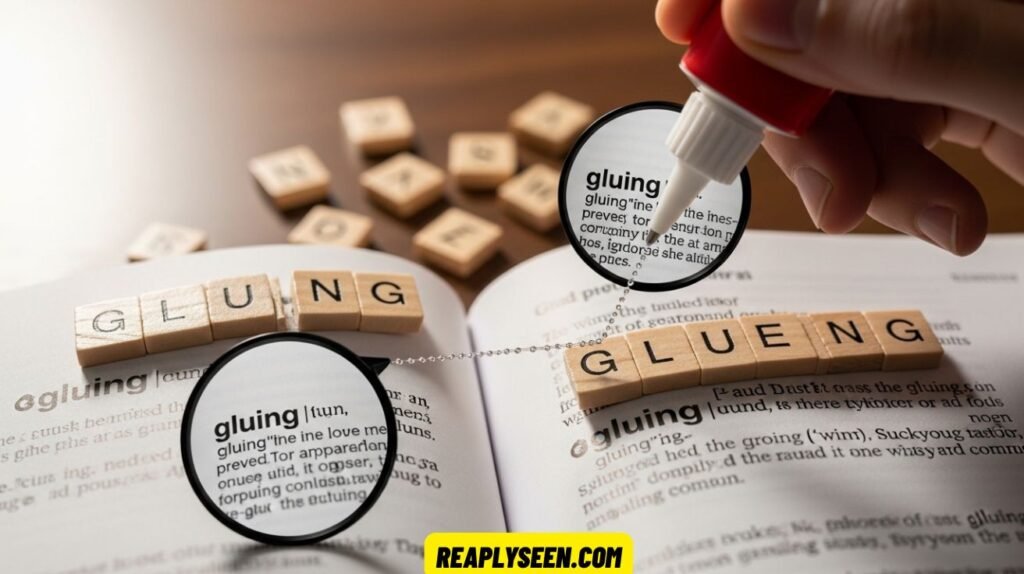
Using glueing in the US can cause problems. Many spellcheckers automatically flag it as incorrect, potentially undermining writing clarity and grammar correctness. Editors and readers may see it as a typo, which affects professional credibility. In academic papers, business documents, or blog posts, maintaining spelling consistency is crucial.
By sticking to gluing, writers avoid unnecessary confusion and demonstrate mastery of English spelling rules, correct present participle formation, and proper verb conjugation.
Memory Tricks: How to Always Spell ‘Gluing’ Correctly
Remembering gluing does not have to be difficult. A simple trick is to always follow the drop silent e rule. Think of the mnemonic: “Gluing sticks together, but the e drops away to keep it neat.”
You can also refer to exceptions for verbs ending in -ee or -ye: for example, agree → agreeing and dye → dyeing. Keeping these rules in mind helps avoid common spelling mistakes and ensures grammar correctness in every piece of writing.
| Verb | Correct Present Participle | Note |
| bake | baking | Drop silent e |
| move | moving | Drop silent e |
| glue | gluing | Drop silent e |
| dye | dyeing | Keep e (exception) |
| agree | agreeing | Keep e (exception) |
Common Misspellings and Similar Mistakes to Avoid
Many writers confuse gluing vs glueing usage or make similar mistakes with other verbs. Common errors include argueing instead of arguing, changeing instead of changing, and mistakenly retaining the e where it should be dropped. Knowing the correct forms ensures spelling consistency and avoids undermining credibility.
Paying attention to these details is part of mastering English spelling rules and improving writing clarity, especially for students, writers, and professionals in the USA.
Understanding the Basics of Gluing vs Glueing
The confusion between gluing and glueing comes from a simple rule in English grammar. When a verb ends with a silent e, like glue, the silent “e” rule says to drop the e before adding -ing. This creates the standard present participle, making gluing the correct spelling in American English.
Even though some British English dictionaries may list glueing as a variant, it is considered outdated. Following the correct spelling ensures writing clarity and avoids common spelling mistakes. Students, writers, and professionals benefit from understanding these English spelling rules and proper verb conjugation.
Why “Gluing” Is the Correct Spelling
In American English spelling, gluing is the universally accepted form. Dictionaries like Merriam-Webster and the Chicago Manual of Style list gluing as the standard, reflecting proper grammar correctness. The drop silent e rule applies consistently to most verbs ending in silent e, including glue → gluing, bake → baking, and make → making.
Using glueing in professional writing can confuse readers or be flagged by spellcheckers. Knowing how to spell gluing correctly helps maintain spelling consistency and strengthens credibility. Writers who follow these English spelling rules also avoid common pitfalls in verb conjugation.
Historical Origins and Etymology of Gluing
The verb “to glue” comes from Old French glu and Latin glū, meaning a sticky substance. Over time, English adopted it into common use, forming the present participle gluing. Early manuscripts sometimes showed both gluing and glueing, reflecting inconsistent English spelling rules before the 18th century.
Historical usage shows that gluing eventually became dominant in both American and British contexts. Understanding this history helps writers recognize language variation and why modern American English spelling favors gluing, reinforcing proper grammar correctness.
Common Confusions and Mistakes with Glueing

Many writers mistakenly use glueing, thinking the -e preserves pronunciation. This mistake occurs because glue ends in -ue, which can trick learners into ignoring the silent “e” rule. Other common errors include argueing → arguing and changeing → changing, which break standard English spelling rules.
Recognizing these patterns improves writing clarity and reduces mistakes in academic or professional contexts. By learning proper verb conjugation and correct present participle forms, students and writers can confidently follow American vs British spelling standards while avoiding outdated forms.
Gluing in Everyday Life and Work
Gluing is used in many real-life situations, from arts and crafts to manufacturing. In schools, students practice gluing techniques during projects. In industries, adhesives often replace mechanical fasteners, highlighting the literal importance of gluing.
Even in technology, software engineers use “glue code” to connect modules, demonstrating a figurative sense of gluing ideas together. Correct spelling in all these contexts ensures writing clarity and professionalism. Avoiding glueing maintains credibility in reports, manuals, and online content.
See Also : Deepest Sympathy – Meaning, Usage, and Examples
British vs American Spelling Differences
While British English spelling may occasionally recognize glueing, American English spelling strictly prefers gluing. Similar differences exist with words like color vs colour and traveling vs travelling, but gluing vs glueing usage is largely consistent across regions today.
Writers targeting a US audience should always follow gluing for professional content. Understanding these spelling differences UK vs US helps maintain grammar correctness and spelling consistency, avoiding unnecessary confusion in formal and academic writing.
Tips to Remember the Correct Spelling
A simple mnemonic helps: “Gluing sticks together, but the e drops away to keep it neat.” Following the drop silent e rule ensures that verbs like glue → gluing and bake → baking are always spelled correctly. Recognizing exceptions like agree → agreeing or dye → dyeing is also important.
Regular practice of correct verb conjugation and reviewing English spelling rules reinforces memory. Writers who internalize these tips maintain writing clarity, avoid common spelling mistakes, and confidently apply correct participle spelling in essays, reports, and online content.
Why Using Glueing Can Harm Your Writing
Using glueing instead of gluing can undermine professional credibility and confuse readers. Spellcheckers flag it as incorrect in American English, and editors may consider it a mistake. This small error affects the perception of grammar correctness and attention to detail.
Maintaining spelling consistency with gluing ensures clarity in academic, business, and creative writing. Following proper English spelling rules helps students and professionals avoid these mistakes, demonstrating strong command of language and correct present participle formation in any context.
FAQs
How do you spell glueing or gluing?
The correct spelling in American English is gluing; glueing is outdated and rarely used.
What is the meaning of glueing?
It means sticking or bonding things together using glue.
Is glued past tense?
Yes, glued is the past tense and past participle of the verb “to glue.”
What does I’m glued mean?
It means I am stuck to something, either physically or figuratively, such as being completely focused on something.
Conclusion
Gluing or Glueing is a small spelling difference that matters in English writing. The correct form in American English is gluing, and it follows the silent “e” rule. Writers drop the e before adding -ing to form the present participle. Using the right spelling helps keep writing clarity and shows that you understand English grammar. Most dictionaries, style guides, and teachers agree that gluing is correct.
Knowing the difference between gluing or glueing makes writing stronger and easier to read. It also avoids common spelling mistakes and keeps sentences professional. Remembering the simple rule helps students, writers, and learners stay confident in their grammar correctness. Using gluing always looks neat and correct.