
Nighttime or Night Time: Unraveling the Correct Spelling
Nighttime or Night Time means the hours of darkness between sunset and sunrise. It is the time when the sky is dark, and most people sleep. In writing, we can use it as a noun or to describe things related to night.
Many people get confused about how to spell it. Some write nighttime as one word, and others write night time as two words. Using the wrong form can make writing look old or unclear.
Nighttime or Night Time is important in stories, reports, and daily writing. In American English, the one-word form nighttime is correct. The two-word form appears mostly in poetry or old books. Knowing the right form makes writing easy and clear.
Understanding the Basics: One Word vs. Two Words

The first step in choosing the right form is understanding the night time meaning and how it differs from nighttime. Nighttime is the standard single-word form used in modern American English to refer to the period of night. For example, you might say, “She enjoys reading during the nighttime.” In contrast, night time is usually seen in historical texts or poetry and is less common in contemporary usage. You may find sentences in old literature like, “Travelers avoided the night time, fearing dangers after dark.”
The key distinction lies in formality and style. Using nighttime one word or two can affect the tone of your writing. Nighttime is considered formal and appropriate for essays, journalism, and professional communication, whereas night time may appear in creative writing or when quoting historical texts. Writers should also pay attention to English grammar rules when choosing between the two, as consistency in usage helps maintain readability and authority in text.
Closed vs. Open Compounds
English often evolves by merging two words into a single form. This is called a closed compound. Examples include daytime vs daytime spelling, anytime, and everyday. Similarly, nighttime is a closed compound formed from the older night time. Closed compounds are widely preferred in American English because they reflect modern language usage and simplify writing.
Open compounds, on the other hand, are two separate words written apart, like night time or high school. While historically common, open compounds often appear in poetic or stylistic contexts rather than formal documents. Writers should remember that using hyphenated words, such as night-time, is still acceptable in British English, but the American preference leans strongly toward the single word nighttime. Understanding the distinction between closed and open compounds is essential for proper nighttime grammar usage.
Historical Development of the Term
The term nighttime did not always exist in its current form. In older English texts, writers frequently used night time as two separate words. During the 1700s and 1800s, British writers often adopted the hyphenated form night-time. Over time, American English gradually moved toward the closed compound nighttime, which is now standard in dictionaries, style guides, and formal writing.
Literary usage of nighttime can still be found in novels, poems, and historical texts. For instance, 19th-century poetry often relied on night time meaning to maintain meter and style. This evolution from two words to a single word mirrors other English language compound nouns, demonstrating how language naturally consolidates over time.
Timeline of Use
The timeline of nighttime vs night time usage shows the gradual shift in preference:
| Period | Common Form | Notes |
| Middle English (1200s–1500s) | night time | Widely used in literature and storytelling |
| 1700s–1800s | night-time | Hyphenated form appears in British texts |
| 1900s onward | nighttime | Standard in American English and dictionaries |
This timeline illustrates that while night-time vs nighttime has a historical basis, modern American writing overwhelmingly prefers the single word nighttime. Writers should be aware of this trend to ensure proper usage.
What Dictionaries and Style Guides Say
Consulting trusted references is crucial for correct spelling of nighttime. In American English, major dictionaries and style guides favor nighttime. Merriam-Webster lists it as the standard noun, while the AP Stylebook and Chicago Manual of Style also prefer the one-word form. Cambridge Dictionary shows regional differences, noting night-time in British English but nighttime in American texts. Collins Dictionary aligns with the single word for clarity and consistency.
In short, if you are writing for a U.S. audience or in professional contexts, when to use nighttime is straightforward: always use the closed compound. This guidance ensures your writing aligns with American vs British English spelling standards.
Usage Trends in American vs. British English

Spelling trends differ depending on location. In American English, nighttime examples abound in journalism, academic writing, and everyday communication. The one-word nighttime is now dominant. British English still occasionally uses night-time, but this is gradually giving way to the unhyphenated form. The two-word version, night time, is largely poetic or historical.
Understanding these trends helps writers make informed decisions. For instance, if your audience is primarily American, adhering to nighttime spelling rules enhances readability and credibility. In formal essays, reports, or blogging, avoiding night time maintains a professional tone.
Google Ngram Viewer Data
An analysis using Google Ngram Viewer shows that nighttime usage in published works rose sharply during the 20th century, especially in American publications. Conversely, night time peaked in the 1800s and has steadily declined. This shift reinforces the consolidation of compound words in English and highlights the modern standard in American writing.
Grammatical Function of “Nighttime”
As a Noun
Nighttime functions as a noun representing the period of darkness. Examples include:
“The park is quiet during the nighttime.”
“Most crimes happen in the nighttime.”
As a Modifier
It can also serve as an adjective to describe activities or qualities related to night. Examples include:
“Her nighttime routine is very organized.”
“The city’s nighttime economy is thriving.”
This versatility makes nighttime vocabulary rich and allows writers to adapt it across various contexts.
Common Mistakes and Misconceptions
Even experienced writers often stumble with nighttime one word or two. A common mistake is using night time in formal essays, which can appear outdated. Another is mixing night-time vs nighttime in the same text, creating inconsistency. Some writers incorrectly hyphenate the word in American English, even when the style guide recommends the single word.
Maintaining consistent usage improves clarity and credibility. Following writing tips for nighttime, such as using one form throughout your work, is the simplest way to avoid errors.
Real-World Usage Examples
The difference between the two forms can be illustrated with real examples. Modern journalism often writes, “The city never sleeps, and the nighttime lights shine brightest in New York.” Fiction writers might say, “She dreaded the nighttime hours, when the forest grew silent.” Historical texts might still use, “In olden days, travelers avoided the night time, fearing dangers after dark.”
The first two sentences reflect contemporary American usage, while the last preserves literary usage of nighttime in historical or stylistic writing.
See Also : Gluing or Glueing: Which Spelling Is Correct and Why It Matters
Practical Guidelines for Writers, Students, and Professionals
When deciding when to use nighttime, follow these rules: use nighttime in academic papers, business reports, journalism, blogging, and creative writing. Use night time only when quoting a historical source, writing poetry that requires the two-word form, or following British conventions with a hyphenated night-time. By following these guidelines, your writing remains professional and consistent.
Rule of Thumb
For almost all modern writing in the U.S., nighttime is the correct and standard spelling. Reserve night time for rare historical or poetic contexts. Choosing the correct form ensures your work is clear, authoritative, and aligned with contemporary American vs British English spelling standards.
Why Nighttime Spelling Confuses Writers
Many writers often wonder about the correct form: nighttime one word or two. The confusion arises because both forms appear in literature, media, and online writing. While nighttime spelling is standard in American English, night time meaning in older texts can appear as two separate words, creating doubt for students and professionals alike.
Using the wrong form in formal writing can reduce clarity. For example, essays, business reports, or journalistic articles may seem less polished if night time is used instead of the accepted nighttime. Understanding these nuances ensures your work follows English grammar rules and aligns with modern usage.
Nighttime vs Night Time in Modern English
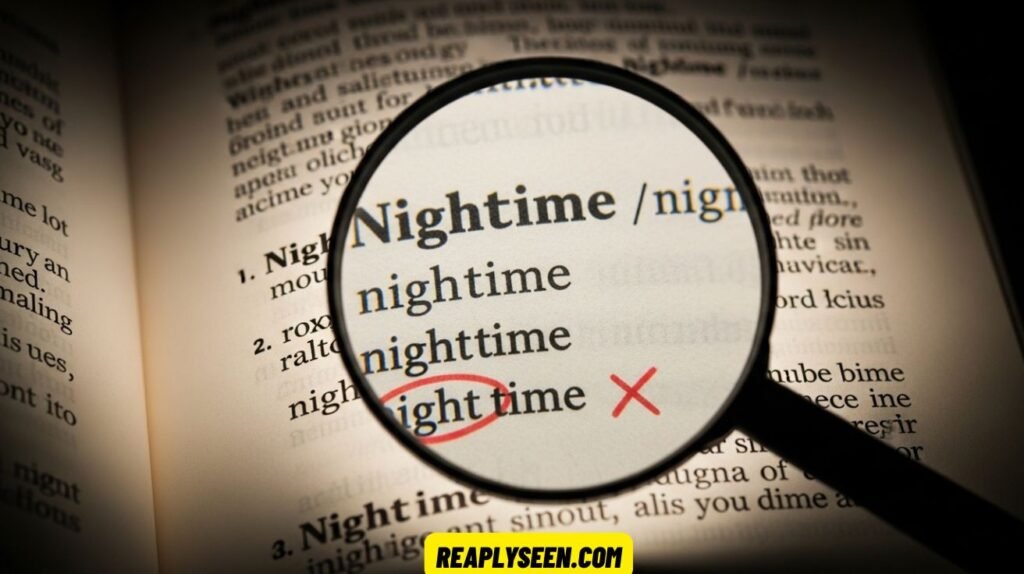
Today, nighttime is the preferred form in American English, especially in academic and professional writing. Nighttime definition refers to the period from sunset to sunrise and is widely recognized in dictionaries and style guides. Conversely, night time is more common in historical or literary texts, emphasizing the time of night rather than standard usage.
Writers should remember that nighttime grammar usage allows it to serve as a noun or an adjective. For instance, “Most people relax during the nighttime” or “Her nighttime routine is well organized.” Using the correct form improves readability and aligns with formal vs informal writing conventions.
How Compound Words in English Evolve
English frequently merges two separate words into a single term. This evolution is seen in daytime vs daytime spelling, anytime, and everyday. Similarly, nighttime evolved from the older night time, reflecting natural changes in spelling and word usage over centuries. Such changes make writing simpler and more uniform for modern readers.
Understanding this helps writers recognize patterns in English language compound nouns. Closed compounds like nighttime are easier to read and more widely accepted, whereas open compounds or hyphenated words like night-time may appear stylistically in British English or in older literature.
The Historical Roots of Night Time
Historically, night time meaning was conveyed as two separate words. Middle English writers used this form in poetry and prose to describe the hours of darkness. During the 1700s and 1800s, the hyphenated night-time appeared in British publications. Over time, American English favored the single-word form, nighttime, reflecting modern spelling conventions.
Even today, literary usage of nighttime can appear in novels, stories, and poetry, especially when an author wants a classical or stylistic effect. Recognizing the historical context allows writers to use nighttime vocabulary appropriately, depending on the audience and tone of the text.
Dictionaries and Style Guides on Nighttime
Most authoritative references, including Merriam-Webster and the AP Stylebook, prefer nighttime as a single word. Correct spelling of nighttime ensures consistency across professional writing, academic papers, and journalism. The Chicago Manual of Style and MLA Handbook also confirm this usage, emphasizing clarity and modern standards.
British English sources sometimes list night-time, but even there, the one-word form is increasingly accepted. Writers should consult these guides to maintain American vs British English spelling standards and to avoid errors when deciding between nighttime vs night time in formal contexts.
Real-World Nighttime Examples
In contemporary journalism, one might read, “The city never sleeps, and the nighttime lights shine brightly.” Fiction often uses sentences like, “She dreaded the nighttime hours when the forest was silent.” In contrast, older texts might read, “Travelers avoided the night time due to danger after dark.”
These examples highlight nighttime spelling in practice. Writers can learn when to adopt the modern nighttime one word or two and when night time meaning might appear for stylistic or historical effect. Using correct form improves professionalism and readability.
See Also : Happy Holiday or Happy Holidays? Exploring the Difference
Common Mistakes Writers Make
Many writers mistakenly mix nighttime vs night time in the same document. Using night time in formal essays or business writing feels outdated and inconsistent. Others incorrectly hyphenate the term in American English, even though night-time vs nighttime shows that the single word is preferred.
Consistency is essential. Following writing tips for nighttime, such as selecting one form and sticking with it, ensures clear and polished communication. Understanding English grammar rules and modern trends prevents errors in both academic and casual writing.
Practical Guidelines for Using Nighttime
For almost all American writing, the rule is simple: always use nighttime. This applies to academic papers, business documents, blogs, and creative writing. Reserve night time for rare cases, such as poetry, historical quotes, or certain British English texts.
Writers should also note that nighttime grammar usage is versatile. It can act as a noun, as in “The park is quiet during the nighttime,” or as a modifier, as in “The nighttime economy is thriving.” Following these guidelines ensures professional and consistent writing across contexts.
FAQs
Is nighttime one word or two?
Nighttime is one word in modern American English; “night time” (two words) is less common and mainly used in historical or poetic contexts.
Is it nighttime or night time in the Oxford Dictionary?
The Oxford Dictionary lists both night-time (hyphenated, UK) and nighttime (US), noting that the hyphenated form is traditional in British English.
How do you spell nighttime in the UK?
In the UK, it can be spelled night-time (hyphenated) or increasingly nighttime (unhyphenated) in modern writing.
What is the difference between night and nighttime?
“Night” refers to the general period of darkness, while nighttime emphasizes the hours between sunset and sunrise and can also act as a modifier in phrases like nighttime routine.
Conclusion
Understanding Nighttime or Night Time helps make writing clear and correct. The correct and modern form in American English is nighttime, which is one word. This spelling works well in essays, stories, and reports. Writers should use nighttime in almost all situations. The two-word form, night time, appears only in old books, poems, or special British English texts. Using the right form keeps writing neat and professional.
Learning the difference between Nighttime or Night Time also teaches how English changes over time. Words join together to become one, like daytime and anytime. Following these rules helps students write better. Knowing the correct spelling shows care in writing and makes sentences easy to read and understand.