On Friday or In Friday – Which Is Correct?
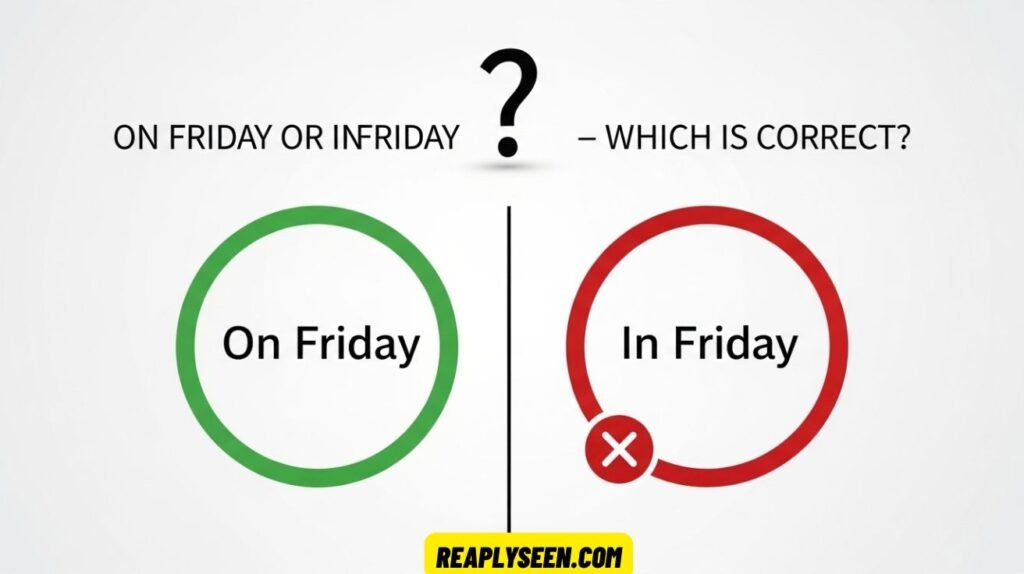
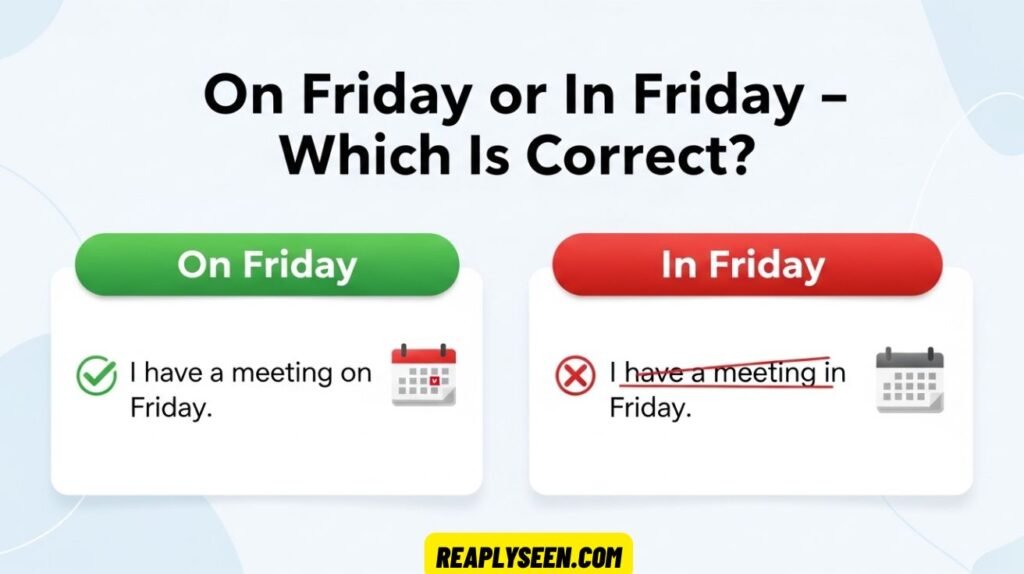
On Friday or In Friday is about choosing the correct preposition for a day. On Friday is correct when you talk about a specific day. In Friday is wrong in standard English.
Many people make mistakes with small words like on and in. Using the wrong word can confuse listeners. Knowing the right preposition helps you speak and write better English.
On Friday or In Friday is used in daily life. You see it in emails, homework, and conversations. Using on Friday correctly makes your English clear and natural.
Understanding Prepositions in American English
Grammar prepositions English play an essential role in connecting words and showing relationships in time, place, or direction. When it comes to English prepositions for time, small words like on, in, and at can make a huge difference. Prepositions help convey exactly when something happens, and using the wrong one can lead to misunderstandings or make your speech sound unnatural.
For example, you would say, “I’ll see you on Friday,” but saying “I’ll see you in Friday” is grammatically incorrect. Days of the week prepositions follow specific rules that native speakers instinctively know, but learners often need to study carefully. Understanding these rules is important not only for writing essays or emails but also for speaking confidently in casual conversations. Prepositions like on, in, and at are not interchangeable, and the distinction often comes down to the size of the time unit being referred to. A day is very specific, so we use on, while a month or year is larger, which is why we use in.
Why “On” Is Used with Days of the Week
When talking about a specific day of the week, English uses the preposition on. This is because on signals a precise point on the calendar, almost like pinning a note on a particular day. For example, you would say, “The meeting is on Friday,” or “I will travel on Friday morning.” Using on with days makes your sentence clear and easy to understand.
Many learners confuse preposition on vs in, thinking “in” might work with days. However, in Friday is incorrect in standard English because in refers to larger containers of time, such as months, years, or seasons. For example, “We met in April” is correct, while “We met on April” is not. The distinction may seem subtle, but it is fundamental for correct grammar usage in English.
Correct Usage of “On Friday” in Sentences
Using correct preposition for Friday is simple once you understand the rule. In formal situations such as business communication or academic writing, sentences like “I’ll send you the report on Friday” or “The board meeting will be held on Friday at 10 a.m.” are correct. In casual conversation, you might say, “We’re grabbing coffee on Friday,” which is still accurate but less formal.
To internalize this, try practicing prepositions of time examples with all days of the week. For instance, you can write sentences about your weekly plans, using on Monday, on Tuesday, and so on. Repetition helps you avoid preposition mistakes and makes your spoken and written English sound natural. The key is that “on Friday” works consistently in every scenario, whether you are speaking informally or writing professionally.
Common Mistakes with Day-related Prepositions
Even learners who have a good command of English sometimes make mistakes with days of the week prepositions. A common error is using “in” instead of “on.” For instance, saying “I have a test in Friday” is incorrect, whereas “I have a test on Friday” is correct. Another mistake is using at incorrectly, like “Let’s meet at Friday,” which also sounds unnatural.
Some people even leave the preposition out in formal writing, writing “The event happens Friday.” While this is acceptable in spoken English vs written English, in formal communication like writing emails in English, you should always use on Friday. Avoiding these common English mistakes is crucial for correct grammar usage and professional communication.
Differentiating “On” from Other Time Prepositions
Time prepositions rules can be confusing because on, in, and at all refer to time but at different levels of specificity. Think of it like zooming in on a calendar. In covers a wide shot, such as months, years, or seasons. On focuses on a specific day. At zooms in even further to indicate an exact time.
| Preposition | Used For | Example |
| On | Specific day/date | She called me on Friday. |
| In | Month/year/season | They married in 2019. |
| At | Exact time | We’ll meet at noon. |
A simple memory trick is to picture a calendar. A month or year is a block of time, so we are in it. A single day is a point on that block, so we are on it. A specific hour is a pinpoint, so we use at. Using this method helps prevent preposition mistakes and improves both spoken and written English.
Why “In Friday” Is Inaccurate
In Friday sounds strange to native speakers because a day is too small to be a container of time. You might hear it in poetry or lyrics, where English rules are bent for creative effect, but in standard American English, it is incorrect. Think about it: you are in April because April contains many days, but you are on Friday because it is just one specific square on the calendar.
Using in Friday in professional emails, school assignments, or conversations will likely confuse listeners or readers. To avoid confusion, always stick to on Friday for clarity and precision. Understanding this rule is one of the most important English grammar tips for learners who want to sound fluent and professional.
Integrating “On Friday” into Weekly Planning
When planning your week, you are already using calendar expressions in English that rely on on Friday. For example, you might write “Doctor’s appointment on Friday at 3 p.m.” or “Dinner reservation on Friday evening.” Using correct preposition for Friday in your planning ensures clarity, whether it’s a shared calendar, a planner, or a digital reminder.
This practice also reinforces learning prepositions naturally. By integrating on Friday into daily routines, such as scheduling meetings, classes, or social events, you internalize the preposition rules and improve spoken English vs written English skills simultaneously.
Casual Speech vs. Formal Writing
In spoken American English, dropping the preposition before days of the week is common. Saying “See you Friday” is completely acceptable in conversation. However, in formal writing, like professional emails or reports, you should always use on Friday. The difference highlights the contrast between informal vs formal English and helps learners understand when preposition rules can be relaxed and when they cannot.
This distinction is particularly important for non-native speakers who want to maintain professionalism in writing emails in English while still sounding natural in conversation.
Enhancing Conversational Skills Through Prepositions
Practicing using on with days in conversation can dramatically improve fluency. Start by writing one sentence for each day of the week, such as “I have a meeting on Monday” or “I am visiting friends on Saturday.” Reading these sentences aloud and recording yourself can help you internalize time prepositions rules.
Real-life application, like texting friends or writing casual messages, helps reinforce the learning. Over time, using on Friday and other days of the week prepositions becomes second nature, reducing preposition mistakes and improving confidence in both spoken and written English.
Creative Sentence Construction with “On Friday”
Grammar is important, but so is style. You can make on Friday part of engaging and expressive sentences. For example, “On Friday, the city comes alive with music and street food,” or “She promised me that on Friday, we’d watch the sunrise together.”
By combining correct preposition usage with vivid language, your sentences become more informative, emotional, and captivating. Practicing these constructions helps learners go beyond just correct grammar and use English creatively, which is essential for fluency and effective communication.
See Also : Mine as Well, Might as Well, or Mind as Well? Which Is Correct?
Consistency Across All Days of the Week
The rule for on Friday applies equally to every other day of the week. Using a table can help learners remember the correct prepositions consistently:
| Day | Correct | Incorrect |
| Monday | on Monday | in Monday |
| Tuesday | on Tuesday | at Tuesday |
| Wednesday | on Wednesday | in Wednesday |
| Thursday | on Thursday | in Thursday |
| Friday | on Friday | in Friday |
| Saturday | on Saturday | in Saturday |
| Sunday | on Sunday | in Sunday |
Consistency is key. Practicing all days of the week prepositions ensures that you never make mistakes and helps you sound natural in both casual and formal English.
Why Prepositions Matter in English

Prepositions are small words but play a huge role in grammar. They tell us about time, place, and direction. When learning grammar prepositions English, many students struggle with small differences like “on” versus “in.” Using the wrong preposition can make your sentence confusing or incorrect. Learning the rules for days of the week prepositions is essential for clear communication.
Time prepositions are especially important in English. Words like on, in, and at help pinpoint when events happen. For example, saying “I’ll meet you on Friday” is precise, while “I’ll meet you in Friday” sounds unnatural. Understanding these small words will improve your spoken and written English.
Understanding “On Friday vs In Friday”
The difference between On Friday vs In Friday is simple but important. On Friday is correct because it points to a specific day, while In Friday is grammatically wrong in standard English. This mistake often appears in casual writing or speech but should be avoided in formal contexts. Prepositions of time help you communicate clearly and professionally.
Knowing when to use on helps learners avoid common errors. Days like Monday, Tuesday, and Friday always take on, while months and years take in. Mastering these preposition rules makes your English more natural and confident in conversations, emails, and written assignments.
Using “On” with Days of the Week
In American English, using on with days is standard. When referring to a specific day of the week, “on” shows the exact day. For example, “We have a meeting on Monday” or “The report is due on Friday.” Prepositions like these are key in English prepositions for time and help you avoid misunderstandings.
This rule applies to all seven days of the week. Writing or saying “on Tuesday,” “on Wednesday,” or “on Friday” is always correct. Practicing days of the week prepositions improves fluency and prevents preposition mistakes, especially in emails or casual conversations.
Common Errors with Day Prepositions
Many learners confuse on Friday vs in Friday and make errors. Using “in” for a single day is incorrect because “in” refers to a larger period, like a month, year, or season. Saying “I’ll meet you in Friday” is grammatically wrong and will sound awkward in both spoken and written English.
Another common error is dropping prepositions in formal writing. For example, “The meeting happens Friday” may work in conversation but is not professional. Following correct grammar usage ensures clarity in writing emails in English, academic work, and official documents.
Comparing “On,” “In,” and “At”
Time prepositions rules can be tricky, but understanding the difference between on, in, and at is essential. “On” is used for specific days, “in” for months or years, and “at” for exact times. For example, “The class is on Friday,” “We met in June,” and “The meeting starts at 10 AM.”
This simple comparison helps learners avoid common English mistakes and improves both spoken English vs written English. When practicing prepositions of time examples, visualizing a calendar or clock can clarify which preposition to use.
Applying “On Friday” in Daily Life
Using correct preposition for Friday is easy when planning weekly activities. You might schedule a doctor’s appointment “on Friday at 3 p.m.” or a dinner “on Friday evening.” Incorporating calendar expressions in English into your daily routine helps reinforce proper usage.
Practicing on Friday in real-life situations like texting, emails, or reminders improves fluency. Over time, using days of the week prepositions correctly becomes second nature, making both casual and professional communication smoother and more natural.
Formal vs Informal Usage of “On Friday”
In casual speech, people sometimes drop the preposition and say “See you Friday.” While this is acceptable in informal vs formal English, in professional writing, you should always use “on Friday.” Correct usage reflects good grammar prepositions English skills.
Using on Friday correctly also helps learners avoid preposition mistakes when writing emails in English or creating official schedules. Knowing the difference between casual and formal contexts improves confidence and clarity in communication.
See Also : Of Course or Ofcourse: Which One Should You Use?
Creative and Effective Sentences with “On Friday”
You can use on Friday creatively to make your sentences more interesting. For example, “On Friday, the park fills with music and laughter” or “We promised to meet on Friday for sunrise.” Combining proper grammar with vivid language makes your writing more engaging and enjoyable.
Practicing creative sentences helps learners internalize time prepositions rules naturally. By applying using on with days in storytelling, social media posts, or emails, you strengthen both grammatical accuracy and expressive English skills, enhancing overall fluency.
FAQs
Which is correct, on Friday or at Friday?
On Friday is correct; at Friday is incorrect in English.
Is it in or on Monday?
Use on Monday for a specific day; in Monday is wrong.
Is it on or in Friday evening?
On Friday evening is correct; in Friday evening is incorrect.
Is it in or on Saturday?
Always use on Saturday for a specific day; in Saturday is wrong.
Conclusion
The correct way to say it is “On Friday” when talking about a specific day. Saying “In Friday” is wrong in standard English. Using On Friday or In Friday correctly helps your sentences sound clear and natural. When you write emails, messages, or homework, always use on with days of the week. This rule works for Monday, Tuesday, Friday, and all other days.
Learning the correct prepositions is very important for speaking and writing English. Practicing On Friday or In Friday every day makes it easy to remember. By using the right words, your English becomes better and more confident. Following these simple rules helps you avoid mistakes and communicate clearly.