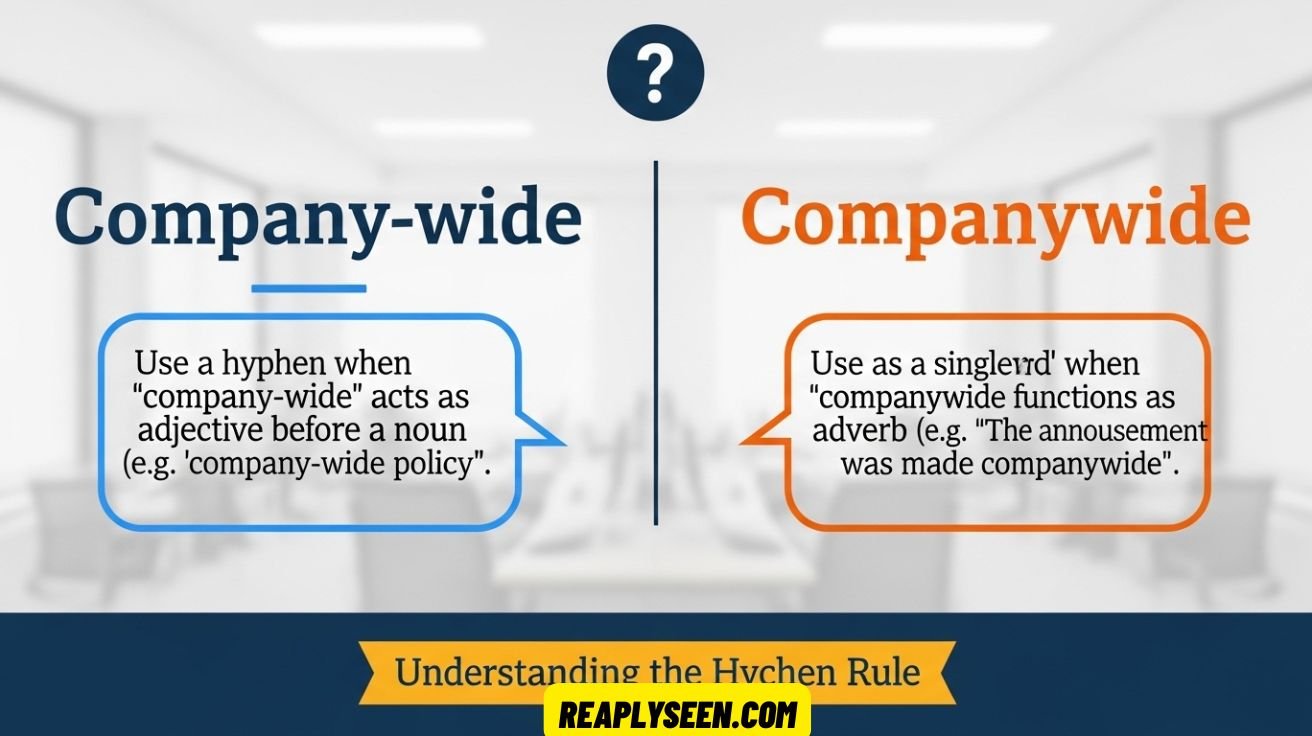
Company-wide or Companywide: Understanding the Hyphen Rule
Company-wide or Companywide means something that affects the whole company. It describes policies, events, or actions that apply to every part of a business. The correct formal form is company-wide with a hyphen.
Many people get confused about company-wide or companywide. Small details like a hyphen can change the meaning. Using the right form shows that your writing is clear and professional.
Company-wide or Companywide is common in business writing. It helps readers understand that a change or policy is for the entire company. Following hyphen rules makes writing easier to read and more reliable.
Company-wide or Companywide? Quick Answer
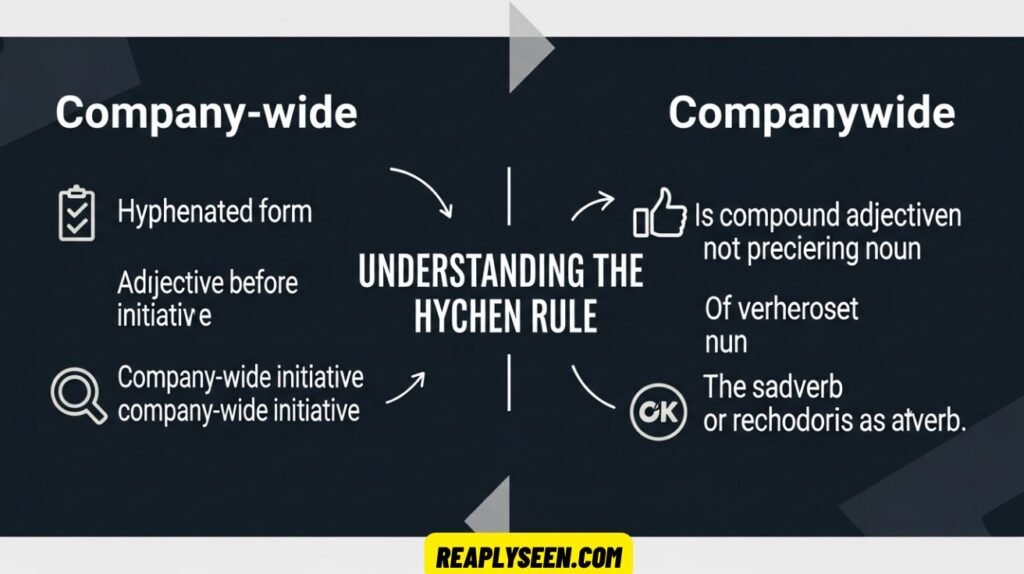
The quick and simple answer is that the correct form in formal writing is “company-wide” with a hyphen. This is especially true when the term functions as a compound adjective before a noun. For example, “We announced a company-wide bonus initiative” clearly shows that both “company” and “wide” work together to modify the word “bonus initiative.” Writing it as “companywide” may appear modern or trendy in informal contexts, but it is not recognized by most major corporate style guides or grammar authorities.
The hyphen is more than a formality; it ensures writing clarity in business and guides readers in understanding your intended meaning. Without it, your sentence may feel awkward, unclear, or even grammatically incorrect. For professionals aiming to maintain a polished corporate tone, using company-wide consistently is crucial.
What Style Guides Say About “Company-wide”
When it comes to formal vs informal writing, leading authorities in English grammar are very clear. The AP Stylebook hyphenation rules state that compound adjectives before nouns must be hyphenated. Similarly, the Chicago Manual of Style hyphen rules recommend hyphenating terms like “company-wide” to ensure clarity. Dictionaries such as Merriam-Webster list “company-wide” as correct and do not recognize “companywide” as standard. The Oxford English Dictionary also recognizes “company-wide” as the formal form.
Here is a simple table showing guidance from major references:
| Style Guide | Recommendation | Notes |
| AP Stylebook | Hyphenate compound adjectives | “company-wide” is correct |
| Chicago Manual of Style | Hyphenate compound adjectives | Follows traditional grammar rules |
| Merriam-Webster | Lists “company-wide” | “Companywide” not listed |
| Oxford English Dictionary | Recognizes “company-wide” | Considered formal and correct |
Following these style guide recommendations ensures grammar for professionals and corporate communication standards are met, which is essential for polished business writing.
Expert Tip:
When in doubt, always hyphenate compound adjectives that precede a noun. As the Chicago Manual of Style advises, “When in doubt, hyphenate compound adjectives before nouns to avoid confusion.” This simple tip helps maintain modifier clarity and reduces the chance of ambiguity in your writing. Paying attention to these details is a sign of careful proofreading and grammar consistency in corporate documents.
Why the Hyphen Matters: Grammar Rule Breakdown
At the heart of this issue is the rule for compound adjectives. A compound adjective is created when two or more words join to describe a noun. When placed before the noun, a hyphen is typically required. For example, “company-wide policy” uses the hyphen to clearly show that both words describe “policy” as a single idea. Writing “company wide policy” or “companywide policy” without the hyphen can confuse readers, reduce writing clarity in business, and appear less professional.
Here is a table showing the effect of hyphenation:
| Without Hyphen | With Hyphen | Meaning Difference |
| company wide policy | company-wide policy | Clear modifier for “policy” |
| industry wide layoffs | industry-wide layoffs | Hyphen prevents misreading |
| organization wide reform | organization-wide reform | Shows single concept |
Using hyphens correctly ensures your writing is easy to read and adheres to corporate style guide standards, making your communication more professional.
What Is a Compound Adjective?
A compound adjective is a group of words that function together to modify a noun. In business writing, they are common and essential for maintaining professional writing tips. Examples include “company-wide meeting,” “industry-wide layoffs,” or “campus-wide survey.” These hyphenated compounds prevent ambiguity and improve the reader’s understanding. Hyphens serve as a visual cue, connecting words that form a single descriptive unit, which is why understanding when to use hyphen is so important.
For instance, “company-wide event” immediately communicates that the event affects the entire company, whereas “company wide event” could be misread as two separate ideas. Correct hyphenation enhances grammar for professionals and overall writing clarity in business communications.
More Examples:
Using company-wide correctly extends to other corporate situations. You might write, “The organization rolled out a company-wide cybersecurity training,” or “Department-wide updates were shared in the newsletter.” These examples show the importance of hyphen rules in maintaining consistent and clear communication. Using “companywide” in these contexts may be understood informally but is not recommended for formal business writing.
Other correct usages include “team-wide notifications” or “industry-wide reform.” Each example demonstrates the use of a hyphen to connect words into a single hyphenated compound word, improving readability and maintaining grammar consistency.
Common Exceptions & Evolving Usage

Language evolves, and informal writing often reflects this change. In casual settings like tech blogs, Slack messages, or internal newsletters, you might encounter “companywide” as a single word. While this is increasingly accepted in informal communication, formal vs informal writing still favors “company-wide” for clarity and professionalism. Some terms, like “nationwide,” have evolved into single words, but “companywide” has not yet reached that stage in corporate style guide recommendations.
Where “Companywide” Shows Up:
Companywide appears mainly in startup press releases, internal communication tools, and casual emails. In these contexts, skipping the hyphen can make writing feel modern or trendier, but it is less precise. For documents that need grammar consistency, legal clarity, or professional tone, it is safer to use company-wide. This distinction highlights the importance of tailoring your internal communication writing to the audience and context.
Should You Use It?
If your audience values professionalism and clear communication, company-wide is always preferred. It should be used in legal documents, official policies, corporate reports, and formal emails. Exceptions might include internal chat messages or branding contexts, where companywide could reflect a more casual tone. Understanding when to use hyphen allows you to balance trendiness with readability and maintain high writing clarity in business.
See Also : Ingrained or Engrained – What’s the Real Difference?
Real-World Examples of Proper Usage
Major companies consistently use company-wide in professional contexts. For instance, Microsoft announced a “company-wide cybersecurity training in 2024,” and PepsiCo shared that “this marks the start of a company-wide sustainability commitment.” These examples illustrate the consistent application of hyphen rules in formal corporate communications, reinforcing grammar consistency and professional writing tips.
From Business News Sources:
In the media, reputable publications follow the hyphen rule strictly. The Wall Street Journal wrote, “The company-wide hiring freeze will continue through the next quarter,” while Forbes stated, “Company-wide initiatives have reshaped our approach to digital transformation.” These real-world cases demonstrate the importance of punctuation for compound adjectives in maintaining corporate communication standards and clarity.
From Corporate Communications:
Within corporate newsletters and HR memos, company-wide is the standard. Companies use this hyphenated form to ensure that employees clearly understand that policies or updates apply to the entire organization. Correct usage reinforces internal communication writing standards and reduces misunderstandings in large organizations.
Similar Hyphenated Terms to Know
Once you understand the hyphen rule for company-wide, it is easy to apply it to other compounds. Terms such as “industry-wide,” “organization-wide,” and “campus-wide” follow the same rule, while some words like “nationwide” have evolved into one word. Here is a table for reference:
| Term | Correct Form | Example |
| Industry-wide | ✅ Hyphenated | “An industry-wide disruption is underway.” |
| Organization-wide | ✅ Hyphenated | “They rolled out an organization-wide restructuring.” |
| Campus-wide | ✅ Hyphenated | “The campus-wide alert system was updated.” |
| Nationwide | ❌ Incorrect | Already one word |
Using these hyphenated compound words correctly enhances writing clarity in business, ensures grammar consistency, and adheres to style guide recommendations.
Grammar Rule Recap: When to Use Hyphens
To summarize, hyphens should be used when forming compound adjectives that appear before a noun. When the modifier follows the noun, the hyphen may be optional, but retaining it is recommended for formal writing. The following chart provides a clear reference:
| Position in Sentence | Rule | Example |
| Before a noun | Use hyphen | “A company-wide event” |
| After a noun | Optional | “The event was company wide” (less common) |
Mastering these hyphen rules ensures your writing maintains grammar for professionals, supports corporate communication standards, and improves modifier clarity. Consistency in hyphen usage demonstrates attention to detail and professionalism in all types of business communication.
The Importance of Hyphens in Professional Writing
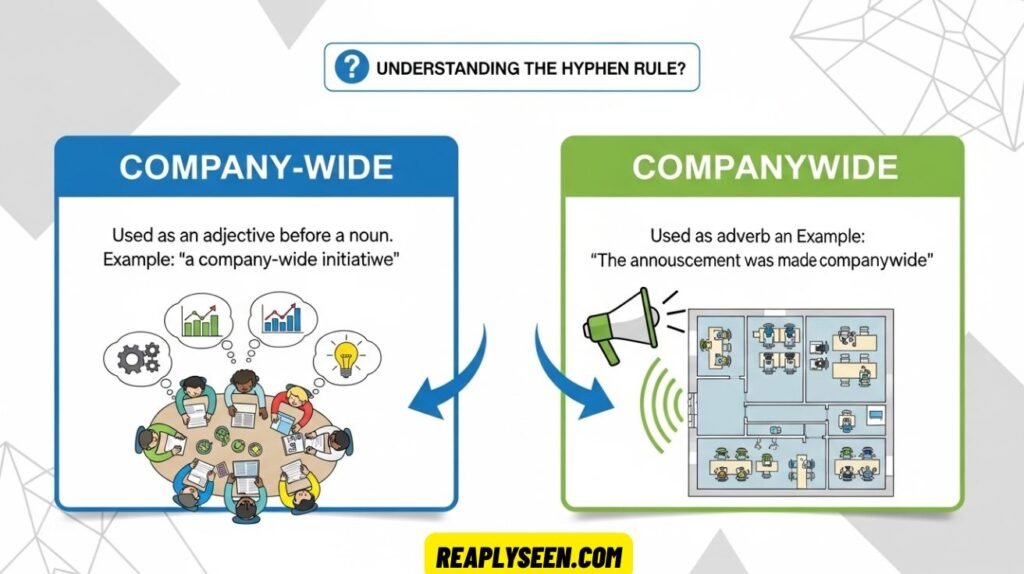
Hyphens are small but powerful marks that significantly impact writing clarity in business. They connect words to form hyphenated compound words like “company-wide,” making sentences easier to read. Ignoring hyphens can confuse your audience and reduce professionalism. Understanding when to use hyphen ensures your documents, emails, and corporate communications are precise and effective, enhancing grammar consistency across your materials.
Using hyphens correctly also signals attention to detail in internal communication writing and general business writing grammar. It shows that you respect the rules of professional English and adhere to style guide recommendations like the AP Stylebook hyphenation and Chicago Manual of Style hyphen rules. Small marks can create big differences in clarity and credibility.
Company-wide vs Companywide: The Core Difference
The main difference between “company-wide” and “companywide” lies in hyphenation. Company-wide is the standard form in formal writing and functions as a compound adjective modifying nouns. Without the hyphen, “companywide” may appear trendy but can confuse readers. Proper use of hyphens ensures modifier clarity and prevents misreading, particularly in corporate style guide-compliant documents.
In informal contexts, such as tech blogs or internal chat messages, companywide sometimes appears without the hyphen. However, relying on informal usage may reduce professionalism. For formal documents, using company-wide demonstrates adherence to grammar for professionals and upholds corporate communication standards, maintaining credibility in emails, policies, and reports.
See Also : Heard vs Herd vs Hurd: What’s the Real Difference?
How Style Guides Influence Hyphen Usage
Leading style guides like the AP Stylebook hyphenation and Chicago Manual of Style hyphen rules provide clear guidance. They advise hyphenating compound adjectives like “company-wide” before nouns to maintain clarity. Following these guides ensures your writing meets professional writing tips standards and avoids ambiguity, particularly in corporate communications or legal documents.
Dictionaries such as Merriam-Webster and Oxford English Dictionary also recognize “company-wide” as the proper form. These references reinforce the importance of grammar consistency. Writers who adhere to style guides produce content that is professional, readable, and consistent, which is essential for proofreading business documents and maintaining high-quality corporate communications.
Compound Adjectives Explained Simply
A compound adjective is made when two or more words work together to modify a noun. In business writing, “company-wide initiative” is an example where both words describe the initiative. Using a hyphen ensures writing clarity in business and avoids ambiguity. Without a hyphen, the meaning can become unclear or misread by employees and stakeholders.
Compound adjectives like these are common in professional emails, reports, and presentations. Mastering them improves grammar for professionals and supports internal communication writing. Proper use demonstrates that you understand the rules of English, maintain modifier clarity, and can convey complex ideas with simple punctuation.
Examples of Correct Hyphenation in Business
Correct usage of hyphens strengthens communication. Phrases like “company-wide meeting,” “industry-wide layoffs,” and “organization-wide reform” are standard. Each term connects words to create a hyphenated compound word, which improves readability and professionalism. Following style guide recommendations ensures consistent formatting across all corporate documents.
Incorrect usage, such as “companywide meeting” or “industry wide layoffs,” can reduce credibility. Maintaining proper punctuation for compound adjectives demonstrates attention to detail and respects corporate style guide standards. Clear hyphenation prevents misinterpretation and makes policies, announcements, and internal communications easier to understand.
Common Mistakes Writers Make
Many writers mistakenly omit hyphens or combine words too early, leading to forms like “companywide” or “industry wide.” This can reduce grammar consistency and confuse readers. Recognizing when to use hyphen helps prevent these mistakes and ensures writing clarity in business. Proper usage enhances professional credibility and shows adherence to accepted rules.
Another common error is over-hyphenating after the noun, such as “the meeting was company-wide” when the modifier follows the noun. While acceptable in rare cases, consistency matters most. Writers should follow formal vs informal writing distinctions and rely on AP Stylebook hyphenation or Chicago Manual of Style hyphen rules for guidance.
Informal Usage and Evolving Language Trends
In casual settings like startups, Slack channels, or tech blogs, companywide without a hyphen often appears. While this reflects modern trends, it does not align with formal business standards. Recognizing these distinctions helps maintain corporate communication standards while allowing flexibility in casual contexts.
Language evolves, but formal documents still prefer company-wide. Knowing when to embrace informal usage without compromising professionalism is key. Proper hyphenation ensures grammar for professionals, preserves internal communication writing quality, and keeps modifier clarity intact across all official documents and reports.
Real-World Examples from Corporations
Major corporations consistently follow hyphen rules. Microsoft announced a company-wide cybersecurity training, and PepsiCo shared a company-wide sustainability initiative. These examples illustrate writing clarity in business and adherence to corporate style guide standards. Readers immediately understand that the initiative applies to the entire company.
News sources like the Wall Street Journal reported a “company-wide hiring freeze,” and Forbes highlighted “company-wide initiatives” reshaping digital strategy. These cases show that hyphenated compound words are recognized across professional writing tips, corporate communications, and media publications. Using proper hyphenation builds credibility and consistency.
See Also : To Bad or Too Bad: The Quick Grammar Rule for 2026
Similar Hyphenated Terms to Know
Once you master “company-wide,” other terms follow the same hyphen rules. Phrases like “industry-wide disruption,” “organization-wide reform,” and “campus-wide alert” follow consistent patterns. Applying these rules demonstrates understanding of punctuation for compound adjectives and reinforces grammar consistency across documents.
Some terms, like “nationwide,” have evolved into single words. Being aware of exceptions ensures formal vs informal writing distinctions are respected. Correct use of hyphenated compound words improves readability, supports internal communication writing, and aligns your content with corporate communication standards.
Final Tips for Perfect Hyphen Usage
Always check corporate style guides like the AP Stylebook hyphenation and Chicago Manual of Style hyphen rules when writing. Ensuring proper hyphenation improves modifier clarity, maintains grammar for professionals, and strengthens writing clarity in business. Consistent usage signals professionalism in corporate emails, reports, and presentations.
Proofreading business documents carefully for hyphenation errors is essential. Small mistakes can change meaning or reduce credibility. Following professional writing tips, paying attention to punctuation for compound adjectives, and knowing when to use hyphen ensures all communications are clear, precise, and highly professional.
FAQs
Is companywide one word or two?
“Companywide” is sometimes used informally, but the correct formal form is “company-wide” with a hyphen.
What does “companywide” mean?
It refers to something that applies to the entire company, often used in casual or informal writing.
What does “company wide” mean?
“Company wide” without a hyphen is incorrect in formal writing; it should be company-wide as a compound adjective.
Is it collegewide or college wide?
The correct formal form is “college-wide” with a hyphen; “collegewide” appears only in informal contexts.
Conclusion
Company-wide or Companywide is an important topic in writing. The correct form in formal writing is company-wide with a hyphen. Using the hyphen helps readers understand that the words work together to describe something that affects the whole company. Writing clearly shows that you care about grammar consistency and professional communication. Following rules from style guides like the AP Stylebook hyphenation and Chicago Manual of Style hyphen rules makes your writing strong and reliable.
Choosing company-wide over companywide makes documents, emails, and reports easier to read. It keeps sentences clear and prevents mistakes in business writing. Proper hyphen use shows attention to detail, improves internal communication writing, and supports corporate style guide standards. Writing carefully builds respect and trust in all professional settings.