Too Many or To Many? Grammar Explained (With Examples for Clear English Writing)
Too Many or To Many is a common grammar problem in English. “Too many” means more than needed or more than enough. “To many” is usually incorrect and only works in special cases. This small difference can change the meaning of a sentence.
Many learners feel confused because “to” and “too” sound the same. A single missing letter can make your sentence wrong. This mistake appears in emails, homework, and social media. Learning this rule can quickly improve your writing.
Understanding Too Many or To Many helps you write clearly and correctly. “Too many” is used with things you can count, like books or people. “To many” is only correct when “to” shows direction. With practice, you can avoid this mistake easily.
Understanding the Basics: “Too Many” vs. “To Many”
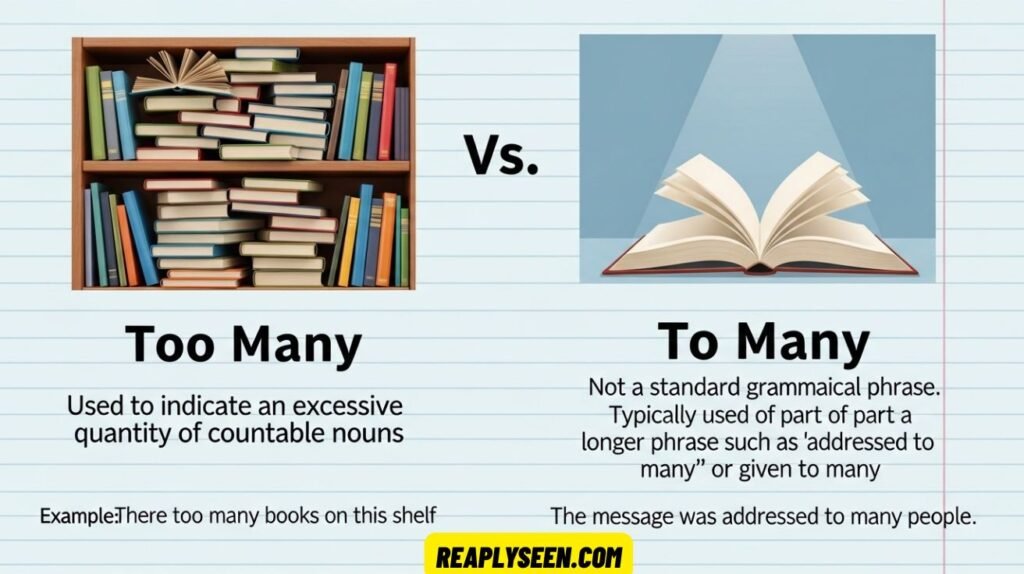
The difference between too many and to many is small in spelling but big in meaning. The word “too” has an extra “o,” and that extra letter changes everything.
The phrase “too many” is used when something is more than needed. It shows excess. For example, if a classroom has more students than seats, you can say, “There are too many students.” This clearly shows a problem.
On the other hand, “to many” is not usually correct when used alone. Many learners ask, is to many correct grammar, and the answer is no in most cases. It only works when “to” is a preposition, such as in the sentence “I spoke to many people.” Here, “to” shows direction, not quantity.
To make this clearer, look at this table:
| Phrase | Meaning | Example |
| Too many | More than needed | There are too many cars |
| To many | Direction or receiver | I sent emails to many clients |
Understanding this simple difference is the first step to better grammar.
The Role of Quantifiers in English Grammar
To fully understand this topic, you need to learn about English quantifiers explained in a simple way. Quantifiers are words that show quantity, such as many, much, few, and little. These words are important because they help describe how much or how many of something we have.
One key rule is knowing the countable vs uncountable nouns rules. Countable nouns are things you can count, like books, apples, or cars. Uncountable nouns are things you cannot count easily, like water, sugar, or information.
This is where the too many vs too much difference becomes important. You use “too many” with countable nouns and “too much” with uncountable nouns.
| Type | Example | Correct Usage |
| Countable | apples | too many apples |
| Uncountable | water | too much water |
These are basic grammar rules for too many, and they help you avoid confusion in writing.
When to Use “Too Many”
Understanding when to use too many is simple when you remember one rule: use it for things you can count. The phrase shows that there is more than needed or expected.
The too many meaning and examples become clear when you look at real-life situations. For example, if your email inbox is full, you can say, “I have too many emails.” If a road is crowded, you can say, “There are too many cars.”
Learning how to use too many in a sentence helps you sound natural in English. It also improves your communication in daily life, school, and work.
Examples in Context
Here are some examples of too many in sentences that show how it works in everyday American English:
“There are too many people in the store during the sale.”
“She bought too many clothes online.”
“We received too many complaints about the service.”
These examples clearly show excess. They are also useful for learners who want English writing tips for beginners.
Common Mistakes
Many learners make errors when using “too many.” These mistakes are part of common grammar mistakes in English, and they can confuse readers.
One common error is using “too many” with uncountable nouns. For example, saying “too many water” is wrong. The correct sentence is “too much water.” This mistake happens when learners forget the countable vs uncountable nouns rules.
Another mistake is forgetting the extra “o” and writing “to many.” These small spelling errors are common grammar mistakes examples that can change the meaning of a sentence.
Understanding “To Many”
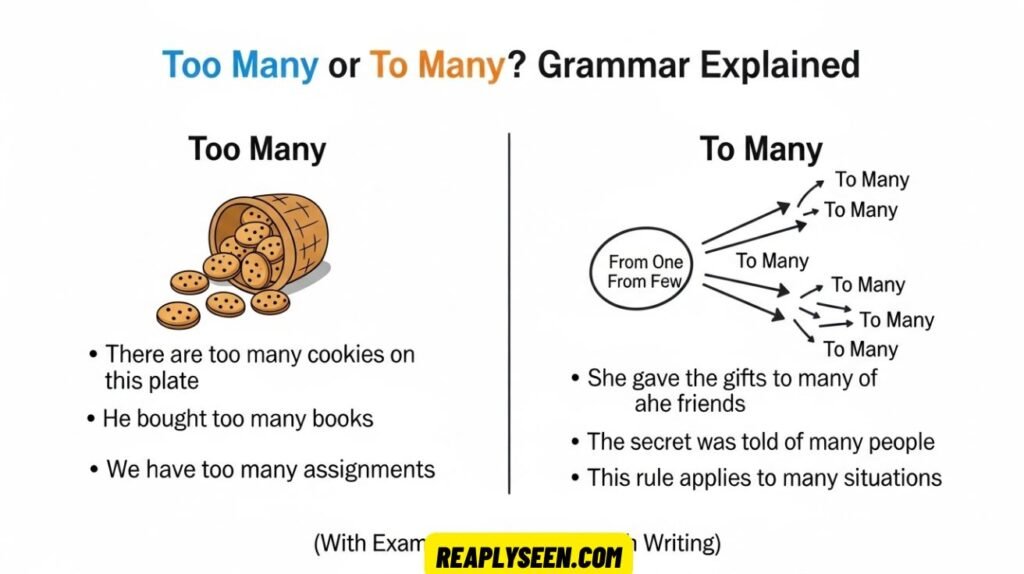
Now let’s look deeper at “to many.” As explained earlier, many people ask, is to many correct grammar, and the answer depends on the sentence.
“To many” is only correct when “to” shows direction or connection. For example, “The teacher spoke to many students.” In this case, “to” is not part of “too many.” It is a separate word.
This is part of the proper use of quantifiers in English, where grammar depends on sentence structure. Understanding this helps you avoid common English errors.
Context Determines Meaning
In English, context is very important. The meaning of a sentence changes based on how words are used. This is why understanding the correct use of too and to is necessary.
Look at the table below:
| Sentence | Meaning |
| There are too many mistakes | Excess |
| I explained the lesson to many students | Direction |
This shows how the same words can have different meanings. Learning this is an important step if you want to learn English grammar step by step.
Common Mistakes and How to Avoid Them
Avoiding mistakes is important for writing skills improvement. Many learners struggle with common grammar mistakes in English, but with practice, you can fix them.
To improve, you should always check your sentences. Ask yourself if you are talking about excess or direction. This simple check can help you how to avoid grammar mistakes.
Using tools like grammar checkers can also help. These tools give useful grammar checker tips and help you correct errors quickly.
Pronunciation Tips
One reason people confuse these words is pronunciation. The words “to” and “too” sound the same, which is why they are often mixed up with “two” in the group too vs to vs two.
Even though they sound the same, their meanings are very different. Learning to recognize them in writing is more important than pronunciation.
See Also : Is It Correct to Say “You Are Missed”? A Complete Guide
Memory Hacks and Rules of Thumb
Simple tricks can help you remember the difference. The word “too” has an extra “o,” which can remind you of “extra” or “more.” This is a helpful tip for English vocabulary tips.
Another trick is to think of “to” as showing direction, like an arrow. These small ideas are useful ESL grammar tips for beginners.
Practical Exercises
Practice is the best way to improve your grammar. Doing exercises helps you understand basic grammar rules and apply them in real life.
Fill-in-the-Blank
Try these sentences:
There are _______ books on the table.
I spoke _______ my classmates.
She drank _______ milk.
We invited _______ guests.
These exercises are simple but effective for improve English writing.
Sentence Correction
Look at these sentence correction examples:
“I bought to many apples.” becomes “I bought too many apples.”
“She explained too many students.” becomes “She explained to many students.”
These corrections help you see real errors and learn from them.
Case Studies: Real Examples in Writing
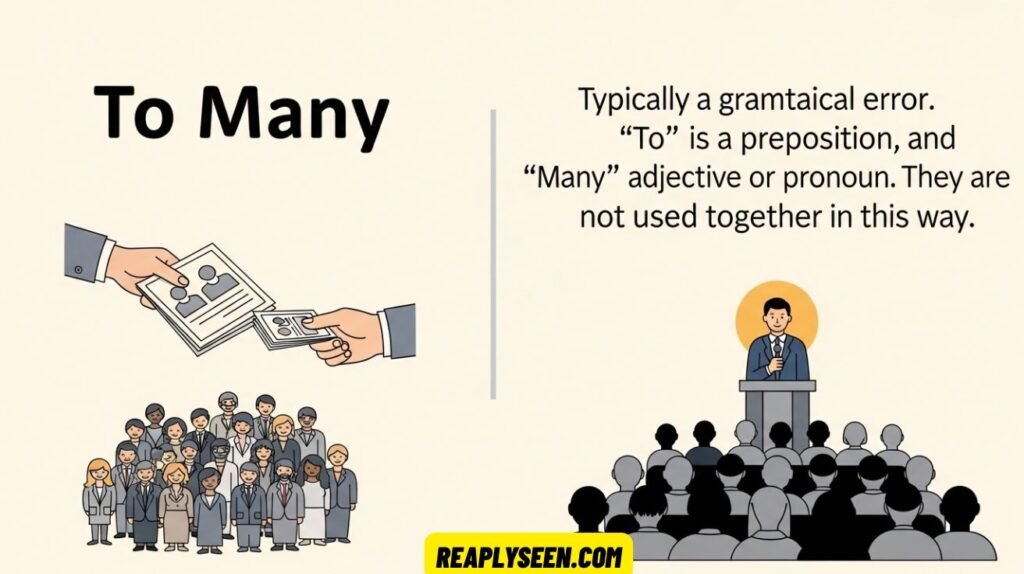
Real-life examples show how grammar mistakes affect communication. These case studies help you understand why correct grammar matters.
Social Media Post Example
A user wrote, “I sent to many messages today.” This sentence is incorrect and confusing. After correction, it becomes “I sent too many messages today.” This change improves clarity and shows the importance of correct grammar in daily communication.
Academic Writing Example
In academic writing, grammar is even more important. A sentence like “The study included to many variables” looks unprofessional. The corrected version, “The study included too many variables,” is clear and correct.
Good grammar improves credibility and helps you succeed in school and work.
Too Many vs To Many: Understanding the Core Difference
The phrase “too many” is used to show excess, meaning more than needed or expected. It is commonly used with countable nouns like books, cars, or people. This phrase clearly indicates that something is beyond a comfortable or acceptable amount in everyday communication.
On the other hand, “to many” is usually incorrect unless it appears in a sentence where “to” acts as a preposition. For example, “I spoke to many students” is correct because “to” shows direction or connection, not quantity or excess.
Why “Too Many” Is Commonly Used in English
The phrase “too many” is widely used in both spoken and written English, especially in the United States. It helps people clearly express situations where something feels overwhelming, such as too many tasks, too many emails, or too many responsibilities in daily life.
Using “too many” correctly improves clarity and makes your message stronger. It also helps avoid confusion in communication. Learning this phrase is important for beginners who want to build confidence and improve their English writing skills effectively.
When “To Many” Can Be Grammatically Correct
Although often considered incorrect, “to many” can be correct in certain contexts. This happens when “to” functions as a preposition followed by “many” and a noun. For example, “The teacher explained the lesson to many students” is a correct and meaningful sentence.
In this case, “to” shows direction or who is receiving the action. Understanding this difference helps learners avoid mistakes and use grammar more accurately, especially in formal writing or academic communication.
The Importance of Countable and Uncountable Nouns
To correctly use “too many,” you must understand countable and uncountable nouns. Countable nouns are things you can count individually, like apples, chairs, or students. These nouns work perfectly with the phrase “too many.”
Uncountable nouns, such as water, sugar, or information, cannot be counted easily. In such cases, “too much” is used instead of “too many.” This distinction is essential for writing grammatically correct sentences in English.
See Also : It’s Called vs It Called: Understanding the Distinction
Common Errors Learners Make with “Too Many”
Many English learners make mistakes when using “too many,” especially by mixing it with uncountable nouns. For example, saying “too many water” is incorrect because water is uncountable and should be used with “too much.”
Another common mistake is confusing “too many” with “to many.” This usually happens because both phrases sound the same. Careful attention to spelling and sentence structure can help avoid these errors in writing.
Simple Ways to Remember the Difference
One easy way to remember the difference is to focus on the extra “o” in “too.” This extra letter can remind you of “extra” or “more than needed,” which matches the meaning of “too many” in a sentence.
Another helpful method is to think of “to” as showing direction, like an arrow pointing toward something. These simple memory tricks are useful for beginners and help build strong grammar habits over time.
Using “Too Many” in Everyday Sentences
In daily life, “too many” is used in many situations to describe excess. For example, you might say, “There are too many cars on the road,” or “I have too many assignments to complete today.”
These sentences are common in conversations, emails, and social media. Learning how to use this phrase correctly helps improve communication and makes your English sound more natural and fluent.
Why Grammar Accuracy Matters in Writing
Correct grammar plays an important role in both personal and professional communication. Using the right phrases, such as “too many,” helps you express your ideas clearly and avoid misunderstandings in writing.
In academic and workplace settings, grammar accuracy also builds credibility. Simple mistakes like writing “to many” instead of “too many” can make your writing look careless, so attention to detail is very important.
FAQs
Which is correct: to many or too many?
“Too many” is correct for showing excess, while “to many” is only correct when “to” shows direction (e.g., to many people).
How do you use to or too?
“To” shows direction or purpose, while “too” means “also” or “more than enough.”
How do I say “too much” in different ways?
You can say “excessive,” “more than needed,” or “an overload of something.”
What is the saying “too many”?
“Too many” means more than necessary or more than is comfortable or acceptable.
Conclusion
You learned the clear difference between Too Many or To Many. “Too many” shows that something is more than needed, while “to many” only works when “to” shows direction with a noun. This small difference can change the meaning of a sentence. Simple grammar rules help you write correctly and clearly. When you use the right phrase, your writing becomes easy to understand and more professional.
You can improve your English by practicing these rules every day. Read simple sentences and notice how “too many” is used with countable nouns. Always check your writing for small mistakes. Strong grammar skills help you in school and daily life. When you remember the rules of Too Many or To Many, you build confidence and write better English with ease.