
Envolved or Involved – Which Is Correct?
Envolved or Involved is about a common English word problem. Involved means taking part in something, being engaged, or describing something complex. Envolved is not a real word and is a spelling mistake.
Many people make the mistake of writing envolved instead of involved. This happens because the words sound similar. Spelling it correctly is important for writing clearly and speaking well.
Using involved helps you show participation, action, or emotional engagement. It is used in school, projects, and daily life. Learning the difference improves your English spelling and confidence.
The Straight Answer: What’s the Deal with “Envolved”?
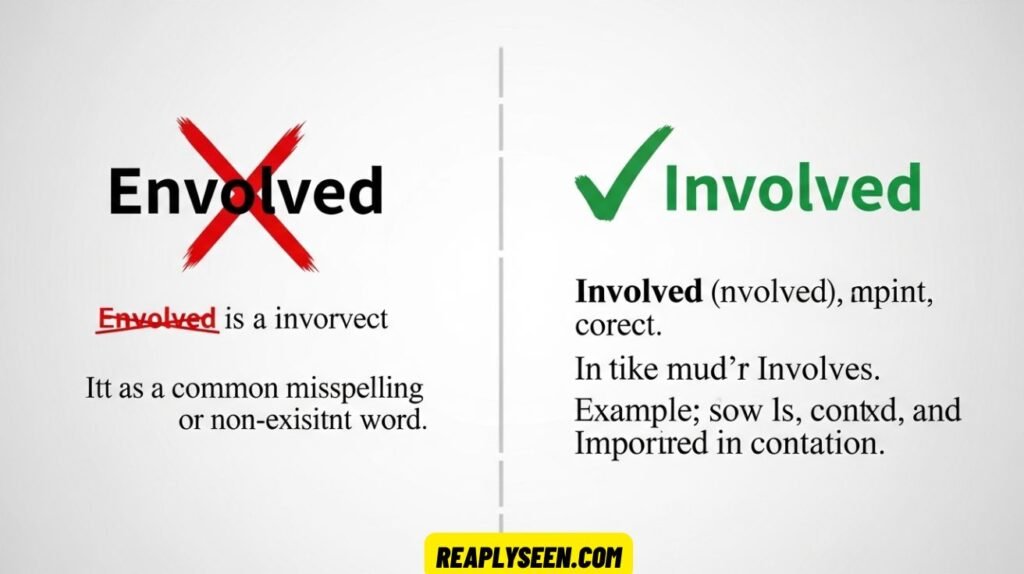
The straight answer is simple: “envolved” is not a word in modern English. Dictionaries such as Merriam-Webster, Oxford, and Cambridge do not recognize it. People sometimes write envolved because it sounds similar to involved or even evolved, which is a real word in English. Autocorrect and typing habits can also lead to this misspelling in English.
On the other hand, involved is a correct word with multiple uses. It can describe someone’s participation in an activity, emotional engagement, or the complexity of a task. For example, you might say, “She is deeply involved in charity work,” or “The instructions are quite involved and need careful review.” By understanding the correct spelling and meaning, English learners can avoid confusing word usage and improve their writing accuracy.
Understanding “Involved” – Definition & Usage
The word involved is versatile and important for English learners. It can be used as a verb or an adjective, making it useful in a wide range of contexts. As a verb, involved is the past tense of “involve,” which means to include or engage someone in an activity. For instance, “The teacher involved all the students in the science experiment.” As an adjective, involved can describe emotional engagement or complex situations. For example, “He is emotionally involved in the project,” or “The process is too involved to explain briefly.”
Correct use of involved strengthens your English vocabulary and allows you to communicate clearly about participation, engagement, and tasks with multiple steps. Learning this word is a step toward better language improvement, especially for those focused on professional writing or academic English.
Definitions
As mentioned, involved has two main uses. As a verb, it refers to including someone or something in an activity or situation. This is the form most commonly used in everyday English. As an adjective, involved describes someone who is mentally or emotionally engaged, or it describes situations that are detailed or complicated. These distinctions are critical for English learners because using the wrong form can lead to vocabulary confusion and errors in formal vs informal English.
Real-World Examples
To understand involved fully, consider these usage examples:
- Participation: “She is involved in organizing the school festival, showing her dedication to community events.”
- Emotion: “He became deeply involved in the local charity work, spending hours every weekend helping others.”
- Complexity: “The contract is quite involved and requires careful review before signing.”
- Professional setting: “Daniel is involved in the marketing campaign and oversees the strategy and execution.”
These examples demonstrate that involved can refer to action, emotion, or complexity. Understanding these nuances is essential for proper word usage and avoiding common mistakes like envolved.
Why “Envolved” Isn’t a Word—But a Common Mistake
Many English learners mistakenly write envolved because of phonetic spelling errors, autocorrect mistakes, or confusion with words like evolved and enveloped. The prefix “en-” is common in English, as in words like “enroll,” “embrace,” or “enclose,” which may mislead writers into spelling envolved instead of involved. Additionally, typing quickly without performing a spelling check or dictionary check often allows these errors to slip through.
Understanding why this happens is part of improving writing accuracy and language learning. By recognizing the sources of confusion, you can avoid repeating this common mistake and confidently use involved in all contexts.
Is There Any Real-Life Use of “Envolved”?
While envolved may occasionally appear in archaic texts or non-native translations, it is not part of modern English. Some historical documents might have used “envolve” centuries ago, but these are outdated and irrelevant for contemporary writing.
In informal blogs, fan fiction, or social media posts, you might encounter envolved, but relying on such sources is risky if your goal is formal English writing. Always trust a dictionary check or grammar correction tools to ensure your writing meets standard English rules.
Quick Comparison: “Involved” vs. “Envolved”
The difference between involved and envolved is clear when displayed in a table:
| Feature | Involved | Envolved |
| Dictionary Presence | ✅ Present in all major dictionaries | ❌ Not recognized |
| Part of Speech | Verb / Adjective | N/A |
| Common Usage | Everyday and formal writing | Rare or incorrect |
| Confusion Sources | N/A | Evolved, Enveloped, Typo |
| Pro Tip | Use confidently | Avoid entirely |
This simple comparison highlights that envolved should never be used in professional, academic, or everyday English.
How to Remember: Never Use “Envolved”
To avoid the mistake of writing envolved, you can use memory strategies and grammar tips. Think of the mnemonic: “Involve starts with I – I participate.” This helps reinforce the correct spelling.
Be aware of the prefix “in-” versus “en-,” and when in doubt, write a sample sentence using involved in context, like “I am involved in the new project.” Over time, repeated practice will improve your English spelling and reduce errors caused by autocorrect mistakes or phonetic confusion.
Common Usage Examples to Anchor Meaning

Practical examples help reinforce the proper use of involved. You might say, “Maria gets involved in charity work every summer,” or “The plot of the story becomes more involved as new characters arrive.” In professional writing, “Avoid overly involved sentence structures—they confuse readers” shows usage in structural complexity.
In emotional contexts, “When you are emotionally involved, it can affect decision-making” highlights personal engagement. These examples are essential for English learners and anyone seeking language improvement.
The Psychology of Confusion: Why You Mistype “Envolved”
Many writers fall into the trap of typing envolved because of visual similarity to involved, mental cross-wiring with words like evolved or enveloped, and informal writing habits. Blogs and social media posts sometimes reinforce this misuse. Typing quickly and relying on autocorrect can also lead to common mistakes. Understanding this psychological aspect helps learners prevent errors and strengthens writing accuracy over time.
The Role of Grammar Tools: Grammarly & AI Checks
Modern grammar correction tools and AI editors like Grammarly, Microsoft Word, and Google Docs are invaluable for catching mistakes like envolved. These tools highlight errors, suggest the correct word involved, and provide explanations to reinforce proper word usage. Using these tools repeatedly improves English writing rules, strengthens your English vocabulary, and ensures consistent language improvement.
Interactive Quiz: Practice Using “Involved” Correctly
Test your understanding with this short quiz. Fill in the blanks with the correct form:
- She became deeply ___ in the project.
- The storyline grew more ___ with each chapter.
- Have you ever ___ yourself in charity events?
- His role was ___ and needed careful focus.
- She is ___ herself in new hobbies.
Answers:
- involved
- involved
- involved
- involved
- involving
This interactive practice helps reinforce the correct use of involved while avoiding envolved. It is useful for English learners and anyone practicing participation and engagement in writing exercises.
Why “Envolved” Confuses English Learners
Many English learners mistakenly use envolved because it sounds similar to involved or evolved. Phonetic similarity often tricks writers into thinking envolved is correct, especially in informal writing. This type of phonetic spelling error is a common hurdle in language learning and can reduce writing accuracy if not addressed.
Autocorrect tools sometimes reinforce this mistake by suggesting envolved based on typing habits or previous word patterns. Awareness of this common error is the first step toward mastering correct spelling and improving English vocabulary for both professional and everyday writing contexts.
See Also : What Does “Gimme” Mean? Definition, Usage & Examples in English
Understanding the Meaning of “Involved”
The word involved has multiple uses as a verb / adjective, making it essential in English communication. As a verb, it describes including someone in an activity, like “She is involved in the project.” As an adjective, it can show emotional engagement or describe complex tasks, which is key in formal vs informal English.
Knowing the meaning of involved helps learners avoid vocabulary confusion and use the word correctly in both spoken and written contexts. Regular practice with usage examples enhances language improvement and strengthens confidence in professional and social English writing.
Common Mistakes That Lead to “Envolved”
Envolved appears in writing mainly due to visual similarity, phonetic errors, and confusion with words like evolved or enveloped. Fast typing and lack of proofreading also contribute to this common mistake. Many learners fail to perform a spelling check or dictionary reference, allowing the error to slip into formal documents.
Informal writing, such as blogs or social media posts, sometimes unintentionally reinforces the misuse of envolved. Understanding these pitfalls helps English learners improve writing accuracy and adhere to English writing rules, avoiding errors that might confuse readers or damage credibility.
Real-Life Usage of “Involved”

The word involved is widely used in both professional and personal contexts. People often say, “She is involved in community service,” or “He is deeply involved in the discussion,” showing participation and engagement. This illustrates how versatile involved is in daily communication and formal English writing.
In contrast, envolved rarely appears in real-life texts. When it does, it is usually in outdated or non-native writings, making it unreliable for modern English usage. Using involved correctly enhances English vocabulary, word usage, and overall clarity in writing.
Differences Between “Involved” and “Envolved”
A clear distinction exists between the two words. Involved is a standard English word present in all dictionaries, while envolved has no recognized meaning and is classified as a misspelling in English. Confusion often arises due to similar sounds or keyboard errors, but only involved is correct for both spoken and written English.
By focusing on correct word meaning and frequent dictionary check, learners can avoid this error. Understanding the differences also improves grammar tips, making it easier to teach others about the correct use of involved in English writing rules.
Tips to Remember Correct Spelling
Remembering the correct spelling of involved can be easy with simple tricks. One method is the mnemonic: “Involve starts with I – I participate,” which connects the word to its meaning of participation and engagement. Awareness of the prefix in- versus en- also helps prevent mistakes.
Frequent practice, writing sentences using involved, and using grammar correction tools like Grammarly or Word can reinforce memory. Over time, these methods strengthen language learning and help learners avoid autocorrect mistakes or phonetic spelling errors.
Emotional and Complex Uses of “Involved”
Involved is not just about action; it also describes emotion or complexity. People can be emotionally involved in relationships, projects, or social causes. Similarly, instructions, legal texts, or reports can be involved, meaning detailed or intricate. Understanding these nuances improves word usage and enhances writing accuracy.
Learning these subtle meanings helps English learners use involved in formal writing and everyday conversation. Exposure to real-world examples ensures learners are comfortable applying the word in multiple contexts without confusing it with envolved.
See Also : Is It Correct to Say “It Was A Pleasure Meeting You”? – Complete Guide
Tools and Practices to Avoid Mistakes
Modern grammar correction tools like Grammarly, Microsoft Word, and AI editors are excellent for catching envolved errors. They flag mistakes, suggest correct spelling, and provide explanations for the correct use of involved. Using these tools regularly improves English writing rules and overall language improvement.
Additionally, practicing interactive quizzes or writing exercises where learners fill in blanks with involved reinforces knowledge. This not only improves English vocabulary but also trains the mind to avoid common mistakes, ensuring professional and accurate writing.
FAQs
What is the difference between involved and envolved?
Involved is correct English, meaning engaged, included, or complex, while envolved is a misspelling and not a valid word.
What is the difference between involve and involves?
Involve is the base verb form, while involves is the third-person singular present tense of the verb.
What is the difference between involve and evolved?
Involve means to include or engage in something, whereas evolved refers to gradual development or change over time.
What does “involved” mean?
Involved means participating in, engaged with, or describing something complex or intricate.
Conclusion
Envolved or Involved shows an important difference in English. Involved is the correct word. People use it to show participation, engagement, or that something is complex. Writers must use involved in their sentences to make their meaning clear. Using envolved is wrong because it is not a real English word. Learning the right word helps students and learners write better and speak confidently.
Using involved correctly improves your English vocabulary and writing skills. You can use it in school work, stories, or projects. Paying attention to spelling and practicing with usage examples keeps your writing accurate. Remembering this rule helps avoid mistakes and makes your English stronger.